Sunday, 19 January 2025

Highs and Lows

This blogpost has turned out very differently from how I had imagined it but that is the vagaries of nature conservation and life itself, the ups and downs.

Last week my patch experienced some severe flooding, rain, snow and then frost swelled the river significantly. Not as high as last year’s winter floods I was nevertheless worried for the safety of my cameras and Otter Cam in particular.


With some trepidation I slowly counted off my cameras until I reached Otter Cam, to my disappointment the camera and even the post it was attached to was gone.  I feared it had been lost for ever but conducted a search. I wasn’t entirely optimistic, the heavy log that the otters like to spraint on had been lifted from the floor and was now lodged on a branch about half a metre above the ground. In a stroke of amazing luck I managed to spot the fence post which the camera had been attached to. It was lodged in a pile of flotsam and jetsam against a large tree. I pulled it free and was pleased to see the camera still attached although now it was coated in broken up undergrowth and thick with frost.

I removed the camera, apart from frozen it looked intact. I cleaned the lens and removed the detritus. It didn’t look wet inside, mainly because it was frozen. I knew the batteries would be shot and so I replaced them and then with great trepidation turned it on. It worked. Not only did it still work it continued to record the whole time.

I was amazed, this camera was not one of the high end Bushnells, Reconyx or the like but a much cheaper Gardepro A3S that I had bought of Amazon at a fraction of the price. I was already impressed by the quality of the camera and now I was bowled over. I recorded a clip and even wrote to tell Gardepro how pleased I was. I really would recommend this company. The device is as good as any of the higher spec models by other makers and I have got some great footage using them.

I was conscious however that one of the reasons it had survived was the severe frost. The water ingress had not had time to rust the contacts, so I purchased another camera to replace it and take that one back for some TLC and to act as my back up camera.

Today with this new camera I went down to do the swap out and make sure the camera was set up correctly, disappointingly however when I got there the camera was gone. Nowhere to be seen. I had noticed some footprints that weren’t my own on my private land, but as long as people do not cause trouble I don’t mind too much, but my camera was gone as was the bracket that attached it to the fence post.

This sort of loss is to be expected, people are sadly people, and I had left the camera unprotected in what I thought was a discrete and out of the way place. I commiserated with a fellow cam user on the Mammal Society Facebook page when he lost a camera and pointed out that for me it was not really the loss of the camera, expensive yes, but cameras can be replaced, it was the loss of data that got me most. I would rather them have the camera and leave the SD card. It’s probably the scientist in me but the loss of seven days of information is gutting. I am at present working on analyzing 10 years of data for my main camera in a hedgerow and I know how much every capture means to drawing reasonable conclusions.

So instead of an uplifting tale of the little camera that could we have a melancholy ending in which I am now going to have to spend out on python locks, padlocks, new brackets and find a safe location that still fits the methodology I am using, and in the process have lost at least 2 weeks of data.

This is the tenth camera I have lost and the fourth that has been stolen. I doubt it will be the last which will be lost to theft or vandalism. I need to be philosophical and focus on the amazing things I have seen with them, and will see as I enter the 11th year of Main Cam and the 5th year of Otter Cam.

For more information on the excellent GardePro Cameras visit their website HERE


Tuesday, 31 December 2024

2024 Birdwatching - A Year in Review

 It is New Years Eve 2024, another year passes us by and I can take a moment to take stock of what kind of birding year it has been. I keep all of my records in some software called Bird Journal and also import that data into the BTOs Bird Track online system to ensure that my records are centrally recorded.

Ferruginous Duck spotted 27th January
Across the past 365 days I have recorded 70 species of bird out of a possible 607 species listed by the British Ornithologists Union, a somewhat measly 12%, however, given that I have not travelled outside the environs of Warwick in all this time I do not think that's too bad.

The year started incredibly well with two lifers. Species I never expected to see. First was a Ferruginous Duck found on the reservoir in Jubilee Wood. The single drake pottered around the reservoir for about a week or so. 

The second lifer was just a day later on my Saxon Mill patch and was a Cattle Egret. This species was almost missed. Little Egrets have become increasingly common on the Avon and by the Saxon Mill. On this occasion amongst the Little Egrets one white wader was not behaving like the others. It was keeping to itself and sticking close to the horses, on closer examination it was possible, even at distance to see the subtle differences.

Cattle Egret spotted 28th January

Graph showing the increase in Little Egret abundance 

As expected most of my birdwatching was done at the Saxon Mill where I racked up 53 species, slightly fewer than previous years but still higher than average. Throughout 2024 I visited the mill to record an official list 48 times recording over a total of 55 hours. The most commonly recorded species was the Woodpigeon and the joint rarest the Sedge Warbler, Reed Bunting, Treecreeper, Pheasant and Mistle Thrush.

Seriously declining species are Bullfinch, Pheasant and Starling but on the positive side this year saw the return of Little Grebes to the patch for the first time in 4 years.


Aside from the Saxon Mill I started to visit St Nicholas Park and Warwick Racecourse more often. I got some nice views of Stonechat at the Racecourse and it is increasingly easier to spot Snipe in the wet flushes. I say easier every single time I have gone to find them I end up flushing them. Even though they are always in the same ditch line they are so cryptic that I never see them before they see me, my goal this year is to get a photograph.

The year ended on a high at St Nicholas Park with two remarkable sightings. Just before Christmas I got some excellent intimate views of a Water Rail by Kingfisher Pool and after Christmas on a rare bright sunny day I finally managed to get several excellent shots of a Red Kite which flew directly over me.

Red Kite over St Nicholas Park 30th December

So what for the new year. Well who know? I would like to get another couple of lifers but I would also like to see some improvement to the species in the area, I want to see more Bullfinch and Marsh Tit. I also want to track down the Tawny Owl on my patch, photograph the Snipe and find a local Barn Owl.

So lots to do - Here is to a great 2025.


Sunday, 22 December 2024

A unremarkably remarkable day.

 Today was essentially a very unremarkable day. We are into winter, weathered a few storms and are heading to Christmas at an alarming rate. It was bright and sunny this morning with a cool wind which if you were out of the suns warming rays could cut right through you.

Siskin (male)
As I do every Sunday I rode down to my patch to see what life was about and to collect the memory cards for my 3 long term mounted camera traps. I was eager to try out a new strap on my binoculars and a little trepidatious of the low battery on my camera. Often the most amazing shots appear when my camera is either forgotten or out of battery. 

The river was still up. My land was flooded last week and although this had subsided rain during the week had swelled the waters and there was evidence of flotsam and jetsam on the banks. Sometimes you get the feeling that the day is a remarkable one but this was not such a day, mundane is the wrong term but it certainly felt a little that way. 

There were no walkers about, in fact I didn't pass another soul for about half an hour as I trudged along the bankside. It was one of those days where some might believe that the lord is on your side. As I walked along the rivers edge I mused that it was at this time in previous years that I have seen a pair of Mandarin Ducks overwintering as soon as this thought coalesced and then dissipated a splatter of disturbed water and the flap of wings alerted me to the presence of a duck flushed from the overhanging willows on the far bank. I suspected it was a Teal but was amazed to see a drake Mandarin streak down river and skid to a halt.

This was the start of a remarkable count. None of the species are remarkable in their nature, each and everyone is common or at least expected on my patch, what was unusual was the fact that so many were seen in the hour and a half I was out  and of these many of the regulars such as the Kingfisher, Grey Wagtail or Dunnock were not recorded.

On this average of average winter days I recorded a total of 29 different species of bird. To put this in context the average species count is anywhere between 17 and 20 species.  29 is a number typical of a summer visit. The arrival of winter visitors such as the Redwing, Siskin and Little Egret certainly helped as did the return of Little Grebe to the site.

Back home I ran through my records to get a little insight. I last had such a similar species count in May with 28 and June with 27. I had to go back to the 16th December 2023 to beat it with 30 species. I had always considered summer with all the migrants to have the highest species count and I think in terms of monthly counts this is still true.

So what did I see to rack up such a list in order of sighting -

Little Grebe
Blackbird
Song Thrush
Great Spotted Woodpecker
Wren
Robin
Magpie
Jackdaw
Cormorant
Goldfinch
Woodpigeon
Blue Tit
Grey Heron
Mallard
Great Tit
Long tailed Tit
Chiffchaff
Carrion Crow
Mandarin Duck
Jay
Black headed Gull
Moorhen
Sparrowhawk
Pied Wagtail
Little Egret
Buzzard
Chaffinch
Siskin
Redwing

It remains to be seen if such species counts continue over the next few weeks.

Sunday, 1 September 2024

The curious case of the headless mole

The victim, image blurred to remove the gore
 It is with a heavy heart that I have to report that a heinous crime has been committed on my patch. At approximately 10:32 am this morning, 1st September 2024, I discovered the body of a velvet clad gentleman.

The individual, of undetermined gender or age was lying on top of some cut grass beside a nettle bed next to the river, with the top of its head missing. The cause of death was immediately obvious, the skull above the lower jaw was completely absent. There was very little blood an no other marks or wounds were on the body. The body was fresh with no decomposition, time of death is estimated to have been within the last 12-24 hours.

To try and understand what happened I have assembled a list of possible suspects who may have committed this murder:

1. A predator

Moles are eaten by a wide variety of animals. They spend most of their time underground and so are rarely predated but given a chance Foxes, Owls, Stoats, Weasels and Buzzards will all take one. There are, however, several problems. Foxes on catching a mole would eat it in a couple of bites. An owl, usually a Tawny Owl would caught the mole first in its talons leaving wounds on the body. It would then likely fly off and swallow the mole from a perch. Likewise the buzzard would catch the mole with its talon and then tear it into small pieces for consumption. Stoats and Weasels are aggressive hunters with surgical accuracy and could account for the targeted strike to the head. The brain is one of the richest parts of the body, full of essential fats and it makes sense that this might be eaten first.

Why though was the body left intact and unmarked? It is most probable that the would be murderer was disturbed in the act and fled the scene.

2. Another mole

Any eyewitness (me) reported that there was some unusual activity in the area prior to the bodies discovery. Whilst sat on the river bank they heard some squeaking and rustling in the leaves beside a tree trunk. He noted that there was a flash of black fur in the undergrowth. The individual was not identified but it could have been another mole. Moles are very territorial and males will fight to the death. Such struggles usually occur underground and involve biting and scratching.

It is unlikely a fellow mole however angry would be able to deliver such wounds and would not do so where both would be vulnerable on the surface.

3. Farmer Giles

At this time of the year mole dispersal takes place. Moles essentially remain underground for most of their lives. In the spring they may venture up to find mates or to feed if the ground is dry. In the autumn the juveniles, now nearly fully grown, leave the home burrows to set up their own system. It is also at this time of year that fields are harvested, tilled and ploughed. The coincidence of wandering moles and the movement of large machinery with metal blades indicates that a terrible accident could occur whereby a mortal blow to the head could quite easily delivered by accident. The meadow was indeed cut short sometime in the past few days and the body was found at the edge of this cut area.

4. Worm retribution

The nature of the wound could indicate some perverse revenge killing was employed by one or more worms or an agent of theirs. The primary diet of moles is earthworms, they eat 50 grams a day. Their tunnels act as traps into which the worms drop. The mole patrols its tunnels and gobbles them up. Moles are sensible fellows and will stash worms in special larders for eating later. To stop the worms escaping they bite the heads off before storing them. Their saliva also has a paralytic agent in to that subdues the worm.

Is the way the mole was left missing its head some grim statement made in a revenge killing?

Of these four suspects I think only really one is viable although I cannot in good faith claim to know for certain. There will be no Agatha Christie moment where I assemble the suspects in the library for a lengthy summation. Instead I think I will just say that a farming accident is most likely. Such things occur with regularity and harvest time can be a dangerous time for small mammals as the threshing, harvesting and cutting machines destroy their homes and drive them away. It is common to see Buzzards, Kestrels, Gulls and Crows following such machines to catch the mammals as they flee.

Sadly this is my third or fourth dead mole I have found in my life and I yet to have seen a mole in real life, alive and well despite the sketchy view I had earlier. For such a common mammal in the UK it really is very rare to see one, dead or alive.

Coming soon did the sparrow really kill Cock Robin? New evidence comes to light.

Sunday, 25 August 2024

The Doldrums

 The seasons create an ebb and flow of life. In late august we are currently in the midst of what I term the doldrums. Robins haven't quite begun to sing their autumn song but things are heading that way. The berries are starting to ripen and the number of bird species are falling.

It is during this time that the summer visitors leave Britain for warmer climates. For my patch the Whitethroats and Sedge Warblers have gone and the number of singing Chiffchaffs and Blackcaps have dropped to the odd one or two. Whereas in spring and during summer an hours visit to my patch would return a bird species list of between 25 and 30 I am now struggling to see more than 15. Those birds that do remain are starting to flock together. The fields have been harvested, tilled and ploughed which has attracted groups of up to 60 Jackdaws. Elsewhere the family of Long-tailed Tits have picked up some friends as juvenile Great Tits and Blue Tits have joined them. These mixed species flocks will grow throughout autumn and stay together as a loose group over winter.

At the same time the number of butterflies and dragonflies is starting to drop off and one might get quite dejected at the lack of things to watch but that is the beauty of nature and indeed of patchwork. There is always something to focus on. Out on my walk today I looked out for other invertebrates. The grasshoppers and crickets are still in abundance although today disappointingly I could only find Roesel's Bush Crickets. These are smart chunky crickets with a consistent churring call but seem to have come to dominate my patch. They are an indicator of climate change their colonisation of the UK from the continent is steadily moving northwards.

Other than the orthoptera I looked for other insects to try and improve my species list. A small bug caught my eye. I took a snap and looked forward to identifying it later. My first guess was a Dock Bug, but cursory examinations of my books made me think twice. The antennae had two pale marks and the abdomen lacked the distinctive wind edges. So off to the net I went and after some research I found out that it was in fact a Dock Bug in its last instar. Instars are larval stages. The Dock bug 4 instars prior to its adult form. Like most insects they grow by shedding their skin periodically revealing a new form, this process is called ecdysis.  The dock bug is not a rare species and I have probably seen it before on my patch but now I have recorded it and have a photo. What could have been a dull uninspiring day turned out to be an interesting one.

Monday, 12 August 2024

The ID Handbook of European Birds - A Book Review

I am an absolute sucker for a beautiful hardback book with amazing images and the two-volume edition of The ID Handbook of European Birds just released as an English translation by Princeton University Press certainly meets that criteria.


The books are written by renowned Dutch ornithologist Nils van Duivendijk with images supplied by Marc Guyt and Agami (images) and are exactly as described, a handbook, a detailed guide to the identification of the birds of Europe. The extensive and impressive work has necessarily been split in to two volumes as is becoming traditional for detailed reference material regarding the birds of the Western Palearctic. The first volume covers non-passerines and the second the passerines.

There is a tradition dating back to the earliest days of ornithology and in fact all aspects of zoology and botany that identification plates and images were the work of talented artists. These highly skilled observers of physiology were able to accurately portray the subtle nuances of a species identifying features. Skilled artists were able to draw together different plumages and stages of life cycle into a series of line drawings  or illustrations. Such images were works of art in and of themselves.


With the advent of digital photography and its exponential increase in the quality of images produced means that photographic images now  provide a more realistic view of the subject in question.

Van Duivendijk has gathered together an incredible range of 5,500 images of 733 European species of bird. All the images are of exceptional quality  both of colour and clarity with perfect lighting and contrast. The accompanying text teases out the key morphological features and details differences between seasonal plumages.


Rather than focus on a single image of the bird the handbook presents a series of images from different angles to highlight the key points. Each bird is cut out to remove the clutter of the background and allows the reader to focus on the salient features. Care is taken to explore easy to confuse species although there are better books out there for this purpose such as The Helm Guide to Bird Identification.


The handbook focuses entirely on identification leaving texts like the Birds of the Western Palearctic to cover the information on species distribution, population size, ecology and behaviour. The books know their place and fulfil their role admirably.

The books themselves are well bound with a sturdy spine and solid hard back. Good quality paper helps do the images justice with the page backgrounds contrasting with the birds well. I do feel however the 2 volume set would have benefitted from a slip case but this is not a deal breaker and would have pushed the reasonable price higher.

The Collins Bird Guide will always be my go to identification guide but this handbook will most definitely augment it and it is a book I will lovingly go through looking at every page and will flick through with regularity. 

The ID Handbook of European Birds is available from all good bookstores.

Friday, 2 August 2024

An exploration of Roe Deer on my patch.

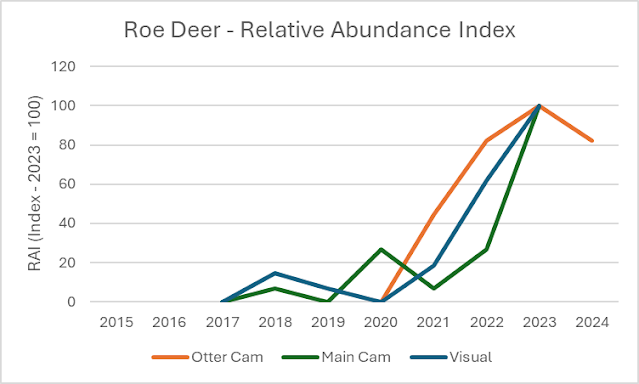
 Roe Deer have become one of the regular mammals on my patch and one of the most endearing. The data thus far collected illustrate a pattern that reflects the general  national increase in deer numbers over the past 10 years.

My patch has been consistently monitored since 2008 and has been under Trail Camera observation since 2014 it is with some confidence then that there were little to no Roe Deer using the site up until their first appearance in 2017.

The Saxon Mill region is good Roe Deer habitat with a mixture of farmland, rough grassland and ephemeral shrub and wet woodland. Quiet stretches of habitat run along the riverbank from Rock Mill northwards and intersects with a railway line that offers excellent connectivity throughout the area. The railway in particular is of great value to dispersing deer and was the primary route for a Roe Deer doe being spotted in Warwick Town Centre in Priory Park in 2023.

Roe Deer Abundance


The index shown above shows how numbers have increased steadily over the years with the greatest increase in abundance occurring  between 2020 and 2022. Otter Cam, a second trail cam set up in 2021 whilst designed to monitor Otter populations actually covered a well liked rest spot for Roe Deer.

This increase in abundance from 2020 reflects an increase in productivity.


Roe Deer Productivity

Relative abundance increased as a direct result of consistent breeding from 2021 which included a set of twins born in both 2022 and 2023. 


Year

Number of kids born

Date Kid first seen (Week Number)

Relative Abundance Index

Main Cam

Otter Cam

Visual

2018

0

-

0.0001

-

0.11

2019

1

1st April (Week 14)

0.0000

-

0.05

2020

0

-

0.0004

-

0.00

2021

1

24th May (Week 21)

0.0001

0.93

0.14

2022

2

17th July (Week 28)

0.0004

1.71

0.47

2023

2

3rd July (Week 27)

0.0015

2.07

0.76

2024

1

10th June (Week 26)

-

1.71*

-

* to date


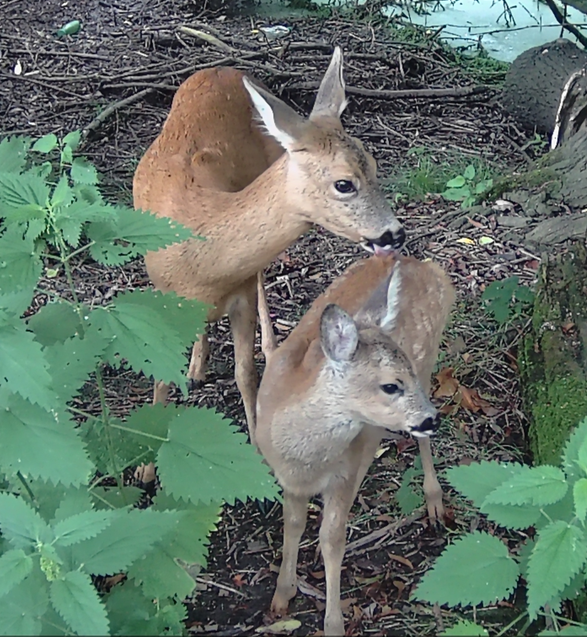
This years doe with fawn

Originally sightings were of a lone female doe or buck moving through the site. Numbers increased from 2019 when they became a breeding pair. 

The best observations were made during 2022 and 2023 when the resident doe and her young became quite acclimatised to my presence and allowed some useful behavioural observations to be made.

Identifying individuals can be quite hard to do from year to year however this year one can identify a number of individuals.

Breeding Doe - This years breeding doe seems smaller than the one seen in 2022 and 2023, it is possible she is one of the four daughters she had in that time or a new individual.

Dominant Buck - Impressive Buck with large antlers this year with 3 tines., one of which is more spatulate. Often seen following the Doe
3 tines Buck

Sub-Dominant Buck - Smaller in stature and size, more flighty and less assured as the Dominant. Has antlers with just 2 smaller tines.

Young Buck - This individual is seen less often, always solitary. Has just a single short tine to his antlers.