Showing posts with label Roe Deer. Show all posts

Saturday, 10 January 2026

Getting to know you

 One of the highlights of the past few years was getting to know a female Roe Deer and her offspring. I saw them regularly, and she became quite used to my presence. Last summer, although pregnant, she disappeared from the area, leaving last year's does to take over her territory. In addition, the formerly dominant Buck, an impressive specimen with antlers sporting three tines, has also disappeared. Antlers are not always indicative of individuality, as they shed each year and may not regrow in the same way.


Over the past few months, two new bucks appeared, both with single-horn antlers, although one of them has only one. In the last couple of weeks, two does have been regularly seen in the company of a buck with antlers in velvet, essentially fur-covered bumps from where the antlers will grow. This new little group are certainly not sure of me, and most of my views are of their white rumps bounding away from me.

Back in 2023, I wrote a post on habituation, and I realised today that I may need to employ these techniques to better watch these amazing animals in the future. Enjoying the winter sunshine, I popped down to my patch to see if the bad weather of Storm Goretti had blown in any interesting birds. It hadn't, I was hoping for Goosander, Teal, Wigeon, maybe some Tufted Ducks, but the snowmelt had swelled the river and flooded much of my patch. As I waded through the water, I flushed the deer. Roe Deer I find will often run off and then pause to look back at you, whereas Muntjac just tear off and disappear.

Rather than just freeze, I decided to show that I was one of them. I stood stock-still and then reacted the same way they did. I tried to look panicked, and I dashed into the undergrowth, stopping and then looking back. I found the deer staring back, bemused. I made my actions fearfully responding to any bird song around me. I avoided direct eye contact and continued to look about as if looking for a predator. Within moments, one of the does and the buck started grazing comfortably, and I was able to remove my camera. I took a few shots so that they could see me with the camera, and it was nothing to be feared and then pretended not to be interested in them at all, looking around me and pawing at the earth as if looking for food.

This tactic seemed to work; all three visibly relaxed, and so I waited until they moved off at their own pace, happy and comfortable. I did not want to push my luck or stress them further, so I left them to it and carried on with my walk. 

That two-minute interaction helped build trust with them. They will never fully accept me, but over time, they won't bolt at the sight of me and will let me sit openly. It takes time and patience, and I do not want them to completely lose their fear of humans. Fear is built into prey species like Roe Deer. It is innate. Roe Deer haven't had a natural predator other than us for hundreds of years, and to breed out such fear will take possibly thousands.

When watching wildlife, always do so on their terms, never sacrifice their comfort for your pleasure or to just get the perfect picture Do not dominate nature, be part of it.

Saturday, 22 November 2025

Blog Update - New book on the way

You may have noticed that there haven’t been any new blog posts for a few months, so I thought I should explain why.

Like everyone, I juggle a busy life, and there are only so many hours in a day. This year has been particularly full. Alongside work and the usual demands of life, I’ve been focused on two major projects: processing and analysing ten years of camera-trapping data from my long-running project, and writing a practical handbook on camera trapping.

The camera-trapping project report was completed and published in July. It’s a project that continues to run, and it was this work that ultimately inspired my latest nature conservation book.

Running a trail camera 24/7 for a decade has taught me an enormous amount — not just about how to use the devices effectively for fun and research, but also about what not to do. I’ve had setbacks along the way: poor images, two cameras stolen, and five more damaged by floodwaters.

But most importantly, I’ve made some truly remarkable discoveries. I’ve confirmed the return of otters to this stretch of the River Avon. I’ve watched a single Roe Deer doe grow into a small group of up to four does and three bucks. I’ve recorded several fox families with cubs. I’ve also, sadly, documented the decline of badgers on the site. Among the countless images, some stand out: otters rolling in the snow, a fox hunting a pheasant, tawny owls catching mice, and even a fleeting glimpse of a polecat.

All this experience led me to start compiling a list of instructions and tips for using trail cameras. That list grew longer as I continued researching ways to analyse the data, and I realised that while there are several excellent books by experts such as Paul Meek and others, there are relatively few aimed at true beginners. And so, the idea for a book began to take shape.

Camera Trapping – A Practical Handbook for Wildlife Researchers and Enthusiasts is the culmination of this work and experience. My hope is that it provides a useful, entry-level resource to help people get the most out of their trail cameras. The book is divided into two parts: the first explores what a trail camera is, how it works, the ethics of using one, and the best ways to deploy it. The second part looks at how to work with the data you collect, including worked examples to help explain some of the mathematics involved.

This isn’t a book for experts; there are far more advanced texts available for those working at a doctoral level, but I hope it fills an important niche for amateur conservationists, students, and anyone curious about wildlife. I want it to give readers the confidence to deploy their own cameras and gain unique insights into what animals do when people aren’t around. I hope it becomes a tool for citizen scientists and local groups looking to better understand the ecology of their area and contribute meaningfully to conservation efforts.

The book has been self-published, like most of my books, through Lulu.com. I am reviewing the final proof copy now, and I hope to have it released for sale within the next 2 weeks. Keep your eye on this blog, my new publications website and my social feeds for updates.


Friday, 2 August 2024

An exploration of Roe Deer on my patch.

 Roe Deer have become one of the regular mammals on my patch and one of the most endearing. The data thus far collected illustrate a pattern that reflects the general  national increase in deer numbers over the past 10 years.

My patch has been consistently monitored since 2008 and has been under Trail Camera observation since 2014 it is with some confidence then that there were little to no Roe Deer using the site up until their first appearance in 2017.

The Saxon Mill region is good Roe Deer habitat with a mixture of farmland, rough grassland and ephemeral shrub and wet woodland. Quiet stretches of habitat run along the riverbank from Rock Mill northwards and intersects with a railway line that offers excellent connectivity throughout the area. The railway in particular is of great value to dispersing deer and was the primary route for a Roe Deer doe being spotted in Warwick Town Centre in Priory Park in 2023.

Roe Deer Abundance


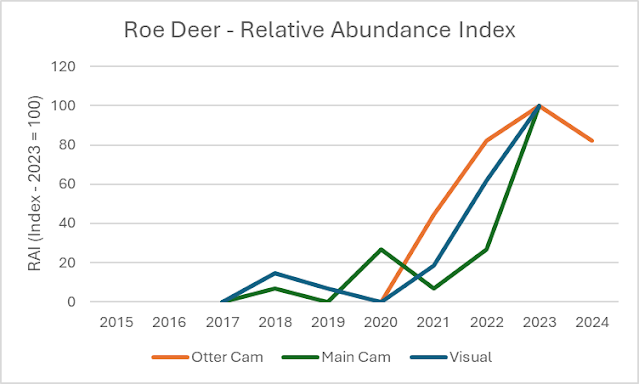
The index shown above shows how numbers have increased steadily over the years with the greatest increase in abundance occurring  between 2020 and 2022. Otter Cam, a second trail cam set up in 2021 whilst designed to monitor Otter populations actually covered a well liked rest spot for Roe Deer.

This increase in abundance from 2020 reflects an increase in productivity.


Roe Deer Productivity

Relative abundance increased as a direct result of consistent breeding from 2021 which included a set of twins born in both 2022 and 2023. 


Year

Number of kids born

Date Kid first seen (Week Number)

Relative Abundance Index

Main Cam

Otter Cam

Visual

2018

0

-

0.0001

-

0.11

2019

1

1st April (Week 14)

0.0000

-

0.05

2020

0

-

0.0004

-

0.00

2021

1

24th May (Week 21)

0.0001

0.93

0.14

2022

2

17th July (Week 28)

0.0004

1.71

0.47

2023

2

3rd July (Week 27)

0.0015

2.07

0.76

2024

1

10th June (Week 26)

-

1.71*

-

* to date


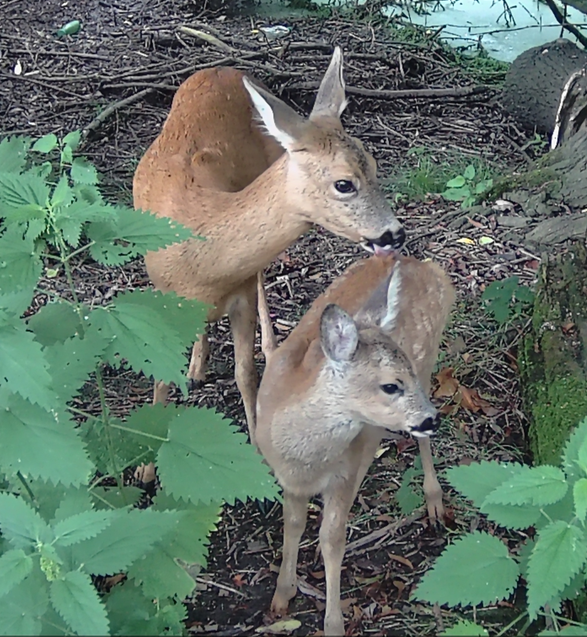
This years doe with fawn

Originally sightings were of a lone female doe or buck moving through the site. Numbers increased from 2019 when they became a breeding pair. 

The best observations were made during 2022 and 2023 when the resident doe and her young became quite acclimatised to my presence and allowed some useful behavioural observations to be made.

Identifying individuals can be quite hard to do from year to year however this year one can identify a number of individuals.

Breeding Doe - This years breeding doe seems smaller than the one seen in 2022 and 2023, it is possible she is one of the four daughters she had in that time or a new individual.

Dominant Buck - Impressive Buck with large antlers this year with 3 tines., one of which is more spatulate. Often seen following the Doe
3 tines Buck

Sub-Dominant Buck - Smaller in stature and size, more flighty and less assured as the Dominant. Has antlers with just 2 smaller tines.

Young Buck - This individual is seen less often, always solitary. Has just a single short tine to his antlers.

Monday, 5 February 2024

Gorillas and Deer - Habituation as a tool for conservation

 This post is an amalgamation of two previous posts one on habituation and one on Virunga. Virunga was a powerful 2014 British documentary directed by Orlando Von Einsiedel that focused on the work of park rangers in Congos Virunga National Park and in particular the struggle to protect mountain gorillas. The habituation post related to my gradual acceptance of my present by the resident Doe and her two young females that have developed this year. Today I had my most intimate and relaxed encounter with them. They allowed me to sit some 40 metres away and grazed naturally mostly at ease, exhibiting natural behaviour. These two disparate things coalesce when considering another recent documentary, Silverback.

Silverback is a documentary by wildlife cameraman, Vianet Djenguet. The explores the themes surrounding the work of conservationists in the Kahuzi-Biega National Park in the Congo and their aim to habituate eastern lowland gorillas for tourism.

Through Vianet we are introduced to the dedicated rangers on the ground, the scientist managers, and the gorillas themselves. Conservation in Africa is difficult and complex, no one can deny the pressures on the local Congolese people living in a war-torn country and often this brings them into conflict with the local wildlife, poaching, and the bush meat trade are particularly disturbing but as a country develops most damaging is the loss of primary forest to make way for cattle, crops and development. The plan, which is already in action, is to habituate gorilla families so that tourists can safely be taken to view them. This tourist trade would provide valuable revenue to fund conservation measures like protecting land and show the local people the value of conserving wildlife around them.

Vianet joins the rangers for 3 months, during which they spent each day with a family of gorillas led by a Silverback called Mpungwe. Vianet started off wholly engaged in the project but slowly came to doubt the merits of the initiative as the knowing doubt that was in the back of my mind the whole time came to the fore.

There is considerable merit in the concept of involving local people in the management of their natural resources and given that all the people shown were from Congo exemplified this and removed any suggestion of the ‘white west’ dictating what the former colonies now do in their own country, but that is a whole other kettle of fish and a debate best saved for another time and place.

Mpungwe was a somewhat aggressive gorilla, but perhaps no more so than would be expected from someone who had lost his parents violently and is disturbed each day by a camera crew, and, here is the crux of habituation, the individual needs to be receptive and have the correct temperament. Mpungwe was not the first gorilla to be habituated, there had been successes elsewhere in the Congo but he seemed wholly unpredictable and unsettled by the whole affair for the techniques to be effective. Whilst there did seem to be some progress, a begrudging tolerance perhaps, Mpungwe seemed unable or perhaps more accurately unwilling to totally accept the presence of humans around his family.

To persevere with the attempts at habituation, which is where the programme left us, risks causing Mpungwe more stress. Doctors live by the Hippocratic Oath, to first do no harm something that Ecologists and scientists should also live by even if it isn't codified in the same way.

Towards the end of the film Vianet seemed to be having second doubts, he acknowledged Mpungwe's discomfort and wondered if this was too high a price to pay. It's a valid point just as the technique of habituation is for tourism, but there is certainly an ethical line that needs to be explored. All of us need to rationalise how far we should go to safeguard a species. How far is too far and who decides?

I am uncomfortable with the concept of habituation, for me, it leads to a change in natural behaviour and desensitising a creature to man can be dangerous, this is less of a problem in this country with my deer per se but where active hunting is a problem then it could be deadly.  For my deer I want them to remain wild, and whilst some habituation makes it possible for me to observe them closer and get some great pictures anymore would be unjust and unfair, for Mpungwe it is much more complex, the rangers of Kahuzi-Beiga are trying to save a species and in the modern world that requires compromise. 

Sunday, 3 September 2023

September Vlog

 This week I experimented with doing a vlog of my patch. A look at what is about and what is happening at this time of year.


Monday, 26 December 2022

Roe deer encounter

 British mammals are notoriously hard to see. British fauna is a mere shadow of that which it once was or that which exists in the rest of Europe. For the most part, gone are the wolves, bears, aurochs, lynx, and the like although there are returning species such as the beaver and the boar, and others are shrouded in the debate over other reintroductions. British mammals have learned to be elusive and are almost exclusively nocturnal. The most seen mammals are Grey Squirrels which as an invasive species have taken over our towns and cities. Mice and rats are often seen but perhaps the rabbit and fox can be counted as the most obvious of our wilder nature.

My trail camera work has shown me the wealth of mammal life all around us, but rarely have I seen these mammals in person. I can count the number of badgers, otters, weasels, stoats, and mink that I have seen each on a single hand. In recent years however the mill has allowed me to get to know a different species, the Roe Deer.

Many of my blog posts have explored these deer and their antics. There are several females and a couple of bucks. Over the last few years, they have successfully bred and this year one of the does gave birth to two fawns. I never saw these fawns in person their mother kept them too closely protected although I did watch them grow on the various video clips and photos from the trail cams. Over the past few months, I have seen the mother and the two fawns, now nearly the same size as her almost every time I have gone down.

The three deer browse in the thick reedy vegetation and they blend in perfectly. Normally I spook them, I never see them before they see me. Every time they bolt and bound off into thicker undergrowth and disappear. My stalking skills have never been very good, and I must confess my patience is too short to stakeout the meadow, there are too many exciting birds and sights to distract me.

This week however what I assumed was amazing fieldcraft was actually something quite different. On Christmas Eve I visited the mill to collect my cameras and I wanted to check on the whips I had planted. As I crossed the meadow area which is covered in brambles, long grasses, and the dried stems of nettles and loosestrife the doe jumped out in front of me. It bounded away from me flashing its white rump at me, holding my gaze, and then it stopped. Normally it would be off and keep going but this time it paused and looked back at me.

Animals and birds tend to be disturbed by eye contact. It triggers in them the flight condition and so whilst I paused stock still I avoided the does gaze. Carefully with my head down, I was able to remove my camera from its case, turn it on and bring it to my face. The doe stuttered a little and took a few steps further before stopping once more and fixing me with a steely glare. Perhaps she had decided to turn the predator-prey tables and was trying to make me flee?

I managed to get a couple of shots off, trying to focus between the vegetation before in what looked like exasperation she bounded off and with a final check to see if I was following bounded behind a bramble patch out of site. The meadow is riddled with animal tracks and the way was quite clear along the backwater where she had bounded but rather than follow her directly, I decided that if I cut round to the right side of the bramble bush and see if I could catch sight of her the other side.

Taking but a step or two to the right I was startled as a second and then a third leaped out of the undergrowth in front of me. The first was so close that I could nearly have reached out and stroked its back. In silence, they bounded after the doe and disappeared. Pulling myself together I moved around the brambles and in the distance saw the three of them running hell for leather into the distance.

Excited by my encounter it took a moment for the event to sink in and for the truth to reveal itself to me. My field craft had not calmed the doe and allowed her to stand patiently as I got my camera and took some shots, far from it she was playing me. What I had experienced is something many species do to distract predators. Although the two fawns were now nearly fully grown, she was still protecting them. Whilst they hunkered down stock still in the undergrowth practically invisible, she tried to distract me and lead me away from them. Her pausing and watching me was her checking to see if I was following, she was taunting me, begging me to follow, awkward me however hadn’t followed her path exactly, instead, I had deviated to the right and come too close to the hidden fawns. The minute I crossed that hidden boundary of comfort the fawns bolted and took themselves to safety.

This fact changes the context of the encounter to one of amazement of a wild animal becoming comfortable with my presence a moment of two souls meeting between a gaze to one tinged with fear and panic. The concern of a mother trying to lead a potential threat away from her young. Young that although nearly fully grown were still dear to her, forgive the pun. In nature, it is hard to equate maternal feelings and at what point that ends. We see it in wildlife documentaries when a cheetah cub is chased off to find a new territory or a bear cub is abandoned to find its own life whilst the mother mates again but, in this case, the doe is still intent on protecting her young.

Roe deer are the only deer to exhibit delayed implantation. The doe will have mated with one of the two local bucks back in July/August but the fertilised egg will not actually implant in the uterine wall until January, this is when I suspect this maternal instinct will fade although the three of them will stick together for a while until the new fawns are born in mid-May.


Tuesday, 15 February 2022

Roe Deer - A local success story

 At the outset of lockdown, I spent my 1 hour of exercise time down the mill on my patch and set up a camera on what I call the bridge. It was over these few weeks that I started to see more and more Roe Deer, in fact, it appeared that they had now become residents on the site.

The area is perfect for Roe Deer. I am used to seeing Roe Deer in woodlands. Around here I have only ever seen them in Warwick Castle Park when I was doing Heronry Census work. My patch is not heavily wooded but it does have a large stretch of scrubland that connects to the railway line. Railways are great conduits for deer to move along and why there are Muntjac in Priory Park in the middle of the town.

Throughout March 2020 I saw small herds of between 3 and 4 individuals some of which were picked up on my main camera. As you can see from the graph below this camera picked solo visits as early as 2015 but it was in 2020 that they started to be seen more regularly. The graph shows the trend as an index of Relative Abundance. This is a function of how many times a Deer is seen and in what number.


It shows a general increasing trend with 2020 being a particularly good year. In both 2020 and 2021, they bred on the site. 

At present, I most regularly see three individuals. An adult buck with antlers, a young male with only pedicles and a female.

The dominant buck is quite bold. The antlers are not fully grown yet, they can reach 30 cms in length and have up to three tines (points). Full-sized antlers do not grow until 3 years old, so it is possible this buck is around 2-3 years old.

Here you can see the Buck with his Antlers in Velvet in January

When not in velvet the full antler set will look like this.

The young buck is possibly last years kid, pedicles tend to develop at 3-4 months and his seem well developed but not enough yet to start growing antlers although these could be the start of his new regrowth

In this image, you can clearly see the 'buds' of new antlers coming through

Roe deer do not form large herds, they prefer small family units or to be solitary. I noticed that once the Kid is born the buck tends to not be seen with the Doe and Kid until the autumn when the family group seems to reform.

The female in the winter can be identified by the anal tush of hair,


The annual cycle as recorded by otter cam, which points across a well-liked rest area can be seen below. 


It shows that they are most active at that site in October, interestingly according to the literature this is the time of fewest reports however this I think is an artefact of using a Trail Cam rather than visual sightings. The distribution of sightings on this camera indicates that the deer are moving into and out of the area. The peak in July coincides with the rut.

Reproductively Roe Deer exhibit embryonic diapause meaning that although mating occurs in July/August the egg only implants in December. Therefore young are born in May/June when the vegetation is high and there is plenty of food. Twins is a common occurrence for Roe does but I have only recorded single kids. This could be because the habitat is sub-optimal or there is an element of postnatal predation from the foxes.

Using data from both the main cam and otter cam I have looked at when they appear most on camera. This graph indicates some level of activity but should be considered with caution.


The graph suggests that the deer are most active in mid-morning and mid-afternoon. This counters the literature that shows that their peak activity is at dawn and dusk. This difference can be explained when it is understood that both camera locations are in quiet well-covered areas. It is in these spots that the deer have chosen to rest up during the day. Whilst they may not rest or sleep, although that has been observed they do seem to like spending a lot of time just chilling there. They often spend between 30 mins to an hour quietly browsing or drinking.

Roe Deer are very well camouflaged and more often than not they see me long before I see them. They are amazingly agile and can disappear into the undergrowth very quickly and for large animals, the largest in this area they do so remarkably well.


Sunday, 27 June 2021

Video Catch Up

 Spring and summer are always a busy time and this year has been no different. With Otter Cam now added to my main camera processing time has increased. A weeks data can include between 200-300 video clips and images. Video clips are each 10 seconds long but that can still take awhile to process and identify the individuals shown.

This has meant that some interesting footage has been recorded but not yet put up and so this post is an attempt rectify that.

First up is a late Spring Video blog to updated the winter one I made,


Next is an update on the youngsters on the site. I had believed the Foxes had not bred this year. The dominant male, Half-tail hasn't been seen since the winter and even then looked very old and haggard. A younger slimmer Fox was seen on the site who I assumed was the offspring from last year, however to my delight a single cub has been sighted on my main camera and I suspect they are using a den site nearby, but with both my spare Bushnell trail cams out of action from water damage I can't check that.

Another of this years treats was the increased number of sightings of Roe Deer. The small herd is perhaps 4-5 strong when the dominant Buck is counted. I noted earlier in the season that one of the does was looking very pregnant and I was looking forward to seeing the fawn. Then nothing, she disappeared for several weeks and I assumed that she had had the fawn and was looking after it out in the scrubby grassland. This week however mum returned to Otter cam and I got some lovely footage of the fawn, all full of life and some nice touches between mother and child. The footage shows the fawn with still some juvenile marking, the white spots are just visible and I suspect it is about a 3-4 weeks old at this point.


Whilst otter numbers are not the same as they were last year the smaller individual is still visiting at least once a week and marking the territory, last week I caught some interesting interactions with the Otter chasing a Muntjac, it is unusual behaviour. Neither is an intrinsic threat to the other but the otter definitely wasn't comfortable with the small deer's presence


To finish up lets look at the Badgers, they have been remarkable absent from my main camera, I think their main passage route has changed and so they don't pass the camera as much as they used to. Even so I have caught the glimpse of a small individual who is probably one of this years Cubs. On Otter Cam however one of the Sows sauntered down and spent a good fifteen minutes cleaning herself and delousing. I love how they sit on their backs and scratch their bellies.


Friday, 31 July 2020

Long term camera trapping study of British hedgerow mammals. 2015-2019


I have finally finished writing up my findings from the first five years of my camera trapping project.
The study explores in detail five species - Badger, Fox, Muntjac, Grey Squirrel and Wood Mouse with some examination of trends in Roe Deer. Brown Rat, Polecat, Weasel, Rabbit and Hedgehog.

The report looks at changes in monthly, seasonal and annual abundance changes and explores the seasonal variation in activity throughout the day and an explanation of key behaviours observed.

The report concludes with an exploration of the methods used and looks at the sort of things that need to be considered when running your own camera trapping study.


Saturday, 21 March 2020

Antlers on the bridge

I have recently purchased a new brand of wildlife trail camera. I usually use Bushnell exclusive and have a couple of Ltl Acorns but decided to try out the Browning. There is a fallen tree across a brook that has silted up creating a little bridge across for all sorts of animals to use. I decided to place the camera here to look at the passage of mammals and get a better look at individuals that use the area.

The number of Roe Deer sightings have increased in the past year or so and there seems to be a small herd of perhaps 4 individuals. I have caught fleeting glimpses of these deer in the distance, they always see me before I see them and move away quickly in typical bounding gait flashing their white rumps at me.

Last year I identified a pregnant female and later a fawn and so I know that the breed in the area. With this new camera I m starting to get an idea of the population. In the clip below we have a fine example of a Roe Deer buck.


The individual seen appears to be a buck in his prime. He has a set of fine antlers which you can see have the standard 3 points and is still covered in velvet.

Roe Deer are generally solitary but form small groups in the winter and the Buck is accompanied by a smaller buck whose antlers only have one point, one of which is strangely longer than the other.


In future weeks I hope to bring you some shots of Roe Deer does as a comparison. Whilst the does are probably still in a group at the moment the eggs that were fertilised in the rut in July/August will have implanted in January. This means the females are likely pregnant in May/June.

Saturday, 22 June 2019

Fawns and Cubs

With the Fox cubs vacating the den area I decided to relocate my second camera, I opted to return it to a Badger sett I know of nearby. The sett has multiple holes and the clan have three cubs. What was most interesting is the variety of other animals spotted on this camera over the week.

The badgers were seen on most nights but not as much as I expected. The cameras placement was between two of the main holes and away from one of the exits into the field, it was therefore possible that they used these other holes more often.

It was with some pleasure that I found that my fox family frequented the site a lot, two cubs and both the Dog Fox and Vixen were seen across the week. It is not unknown that Foxes will cohabit with Foxes and although neither appeared together they were obviously tolerated.

The cubs are still active and like to involve the adults in the below clip  you can see one of the adults taking a tumble when following one of the more exuberant youngsters.


Other than the Foxes most interesting was the amount of time a female Roe Deer and her Fawn spent sheltered under the tree. As I pointed out in an earlier post, I had seen both pregnant Roe Deer and Muntjac. This fawn is the result of this. Now confident on its feet but still with the white spots on its back I got some intimate footage of the two together relaxing. The muntjac actually joined them one afternoon, although the muntjac appeared very wary.


Even Wood Mice were recorded scampering about, unafraid that both Foxes and Badgers frequented the site. Birds also appeared including a juvenile Robin, Great Tit and Magpie. I am amazed how many species will occupy one space each with their own niche and how they hardly seem to interact.

Tuesday, 1 January 2019

2018 - A year in Review

Well there we go 2018 is gone and 2019 is upon us and what a year it was.

This year saw the completion of 15 years of surveys on my patch at the Saxon Mill. Sadly much of the year was lost when the bridge was taken out and left me unable to access the patch. I was able to get some access once work started and meant that I only lost 3 months survey data although this was the busiest time, summer, meaning my nest records, butterfly and dragonfly numbers were down.

Over the year I recorded only 49 species of birds, mainly due to me not being able to record the summer visitors, 2 butterfly species, 3 dragonfly species 3 mammal species and 1 reptile species. Of course the hands down highlight was the Otter sighting on my land in early December.

Speaking of which, talk about two coming along at the same time I saw a second otter on the Avon this time behind Tescos heading towards St Nicholas Park. This one stayed around a bit longer and I was able to really watch the movements and the way the bubbles leave a trail when it swam under water. This animal  seemed smaller than the one I saw at the mill possibly a female or sub-adult. It was also more cautious of me.


On the 31st December my long term camera trap completed its first year in its new location. In its time it was activated 3328 times over the 12 months. New species to be recorded included the Hedgehog and Woodcock. In fact the woodcock was quite active early in the year.

The most frequent observation in order is:

430 - Fox. I now know there is a Juvenile, Half-Tail, No Tail and Full tail. 4 individuals using the site.
415 - Grey Squirrel
388 - Blackbird
246 - Wood Mouse
146 - Song Thrush
142 - Badger
121 - Muntjac

Most interesting in terms of camera sightings was watching the Fix Cub grow up and note the rise in Roe Deer being seen more frequently and in greater numbers.
In fact the most recent sighting was off a Buck with its horns just starting to grow.


Once I have had time to process the data pretty graphs will follow.

Here is hoping 2019 is going to be as exciting and rewarding.

Sunday, 16 September 2018

This weeks star - the Roe Deer

As you are aware the loss of the bridge has meant that I have only just been able to collect my camera and when I did I had over 2000 clips to analyse! I have finally finished ploughing through them and collating the information and I hope to be able to give you some insights in the next few posts especially regarding the presence of a Fox cub.

Today, however, I want to share with you several photos captured this week. They were taken at 11.10 am on the 11th September and show a young Roe Deer.


You can tell this is a young Roe Deer rather than a Muntjac for several reasons. Firstly the head lacks any of the correct markings, secondly, fur is of a different texture and colour. The muntjac has a more orangey colour and is smoother looking, in this case, the fur is coarser. Thirdly you can look at the ears, here the ears are more pointed and more upright whereas muntjac ears are rounder and stick out more from the side. Muntjacs are also shorter legged than this individual, lastly, there are diagnostic black spots on the rear legs.

It is also possible to tell that this is a young deer from its general appearance, the coat looks fresh but lighter than one would get in an adult, it is also possible to see faint white marks on the hin quarters when as a fawn it would have had spots. Last is the eye, juveniles generally have larger eyes in relation to their bodies, this is true for humans too. Eyes are proportionately larger at birth and it takes some time for an animal to 'grow into them'.