Showing posts with label St Nicholas Park. Show all posts

Saturday, 29 June 2024

An afternoon beside a pool.

 We are lucky in Warwick to have a number of fantastic open spaces that contain a variety of different habitats and wildlife. Priory Park is parkland and woodland, the Racecourse is flat grassland with patches of wet patches and St Nicholas Park, although a municipal park aside from the large playing field it has a river, fishing lake and dipping pool.

Alongside Kingfisher pool is a small pond that was recently dredged and cleared. King Henry pool has now recovered and is a flourishing ecosystem with abundant emergent vegetation. At this time of the year it is a magnet for dragonflies and damselflies, they zip around hunting over the water and gently lay their eggs in the vegetation.

Focusing on just the small pool I was lucky enough to see several species. The most obvious were the ubiquitous Banded Demoiselles whose numbers are just starting to ebb. Of the larger species there were a couple of Emperor dragonflies. A male patrolled up and down in a set predictable pattern hawking for insects it would take and devour on the wing whilst a female flitted from area to area ovipositing. She dips the tip of her abdomen in to the water and injects the eggs on to a reed.

Female Emperor ovipositing

Several blue Black-tailed Skimmers were present and a single Four-spotted Chaser.

Four-spotted Chaser

The most abundant however of all the species were the small damselflies, hunting and mating. I only identified two species, Blue-tailed Damselflies and Azure Damselflies. Both are most active at this time of year.

Male and Female Azure Damselfly mating

In a small open patch of water were a mass of Whirligig beetles. These energetic water beetles were whizzing around on the surface like nobodies business. These amazing beetles spin around on the surface. It has a latin name that reflects its nature, Gyrinus substriatus, from the root of gyrate, which these beetles really do.


As if this wasn't enough i was lucky enough to spot a small pike. It couldn't have been more than 10-15cms long. It moved with effortless grace and came incredibly close. I was able to watch it as it stalked various tiny fish. Normally when I watch the large pike on my patch they tend to sit on the bottom and then pounce up. This young jack however patrolled at the surface and struck horizontally.


Young Pike

Of course there were also the birds, Swifts dipped down to feed across the lake and Chiffchaffs sung from the willows, there was also a Jay. 

It just goes to show how much life can exist in such a small space. Of all the species present during my hours visit I barely scratched the surface, a life time could be spent catalogue everything there and I already have that task to accomplish on my patch.

Friday, 15 April 2022

Watching the Hunt

 The Kingfisher is acknowledged by its name alone as the King of Fishers however I feel that one other bird really deserves that title. Yes, the Kingfisher is gaudy and vibrant. Its dashing behavior and striking form show off its fantastic maneuverability and its dives are magnificent, but the true king is the Grey Heron.

There is something noble about these birds and they exude a cold calm deadliness. I have always felt Herons hold something of the prehistoric about them. Perhaps it is their piercing gaze or the scraggy look of their young but they certainly could have fitted into the ecosystem alongside those early birds of the Jurassic.

I was given cause to think about Herons today. They are not a rare sight in Warwick, in fact, the town boasts a substantial Heronry and they can be seen across the waterways from the Canal to the River, as well as taking easy meals from the fishponds of the Woodloes. This Heron was probably one I have photographed before. By the canal bridge on the Avon upstream of St Nicholas Park is a favourite haunt for this species and I often come across one fishing in the brook that enters the river here. Today I spotted him from the bridge above and so had a good view looking down on him. He was obviously fishing, he stood stock-still, then every now and again he poised in the strike pose, hunched, with his neck drawn back.

What interested me almost more than the Heron himself were the passers-by. Some walked past completely oblivious, others noticed but were uninterested, and then there were those that paused and smiled. Some stopped just a moment to watch whilst others reached for the ubiquitous mobile phone. I was heartened to see that all of them treated the bird with respect. They didn’t approach too close or move unnecessarily for the whole 20 minutes I watched him he was not disturbed once and was able to catch and eat three fish.

People passing on the bridge noticed him and went down for a closer look and a younger man with a basketball cap stopped took a few photos and then, as he moved off gave the Heron a little wave as if in thanks. Lastly, I met a couple who knew the individual, they lived close by they told me they saw the Heron regularly and had named him Henry. A fitting name for a very fine heron.

Turning back to the fishing, I have spent many hours watching both Kingfishers and Herons whilst hunting, and anecdotally I can honestly say that the Heron has a better strike rate. On one occasion some years ago, I watched a Heron down at the Saxon Mill hoover up several fish and then follow it with a bank vole! Up in Scotland, I saw a Heron catch an eel nearly as long as he was tall, wrestle with it and then swallow it.

Henry was no different today catching a sizeable wish and downing it in one.


Sunday, 24 March 2019

The Grey Heron

This weeks post is a photo story about the Grey Heron. Heron are a common sight around Warwick. A sizeable Heronry exists in the town and so at this time of year Adults can be found all over the local waterways looking for food.

On Saturday a chance encounter led to a intimate connection with one of these prehistoric birds. A series of small brooks join the Avon, one of which runs near the canal aquaduct. This brook was gushing with water, swelled by overfill from the canal and in it I stumbled upon the Heron.


It was stood leg deep in the water, pacing along its edge. Normally Herons are very flighty. On my own patch they rarely allow you to get close than 15-20 metres but this individual was remarkably unconcerned. Looping around so as not to disturb it I paused on the bridge and unslung my camera.

The heron was well aware of my presence. They have amazing eyes. They are place on the sides of the head allowing for good all round vision but are able to twiddle them forward to give great binocular vision for the all important hunt.


Aside from myself several others came past and stopped to watch, each passer by elicited little more than a glance unless of course they had a dog, where the heron would become more agitated. It would gape its beak and extort a harsh croak.

After a short while, tired of fishing it flapped up onto a branch and proceeded begin a grooming cycle. This further reinforced how comfortable the bird was now barely 5 metres from me. It gave me a chance to watch as it bent its neck around to check the chest plumage and rearrange the feathers under the wing. It occasionally supplemented this with a scratch from one of the legs.


Such a comfortable close up gave me a chance to really explore the animal and focus on the eye and beak. The beak is a solid thing and you can see how its dagger shape is well suited to catching slippery and wriggling fish as well as hopping amphibians and scampering voles. As I mentioned before, the eyes are a sight to behold. There is something primitive and almost dinosaur like in their gaze. When you stare into the eyes of a heron you really can believe they evolved directly from the small theropod dinosaurs.


Saturday, 30 July 2016

Warwick in Bloom

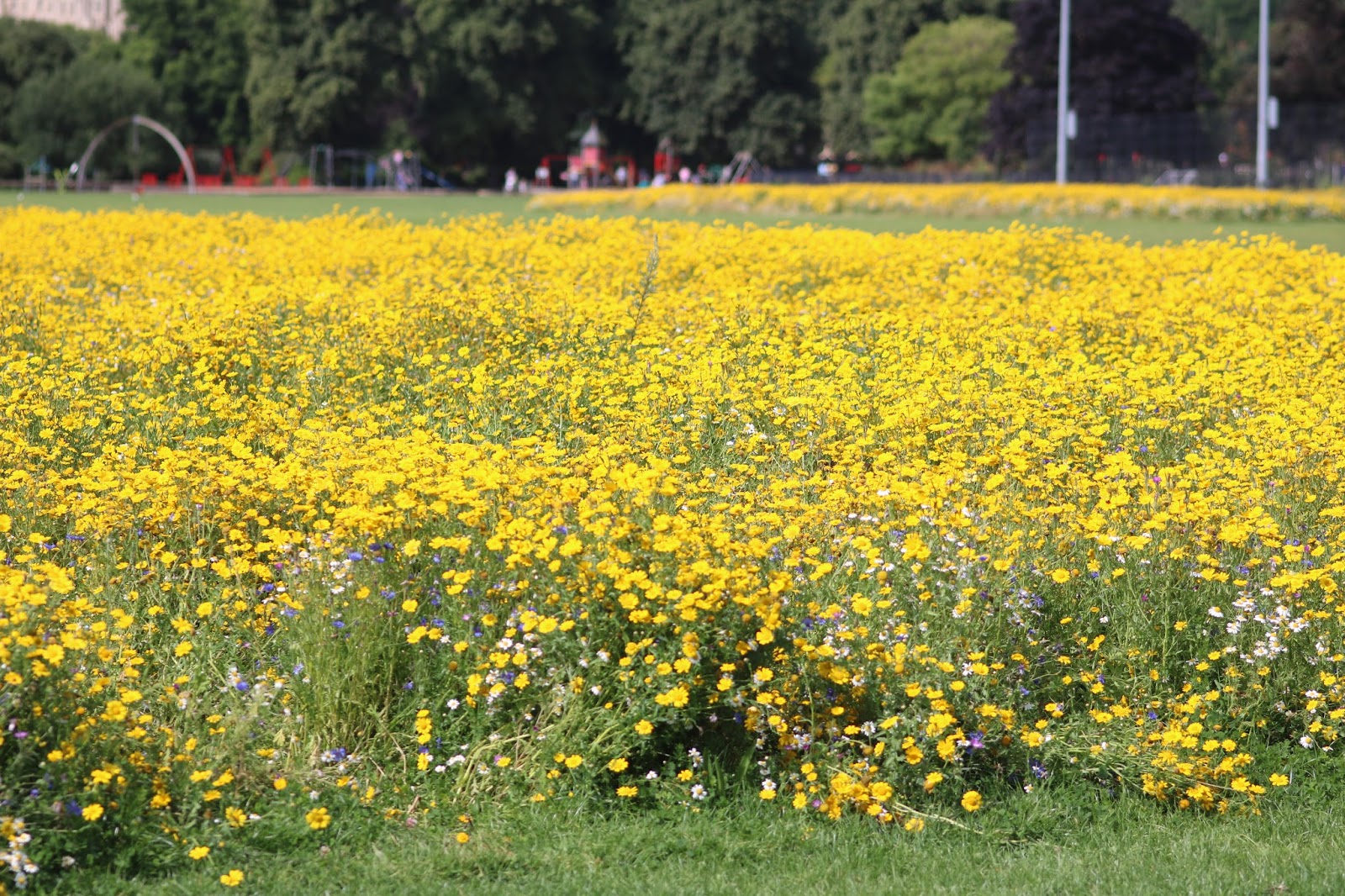
Earlier in the year I wrote to the local papers to publicly thank the District Council for planting a wildflower strip at St Nicholas Park. At the time there was some local resistance as it was claimed that it looked unsightly, this of course was the preparation phase and now I can report on how it looks in full bloom.


The council have planted a range of plants include Ox-eye Daisy, Cornflower and Corn Marigold. Today the strip was a buzz with bees and flies. I had hoped for more butterflies - I only saw a Large Skipper and a Meadow Brown but it was early in the day and there was a wind. 

Some of the species seen included:

Eristalis arbustorum

Harlequin Ladybird

Red-Tailed Bumblebee

Stenodema calcarata 

Honey Bee (Worker)


Friday, 25 March 2016

Good Friday, Good Day

After a week of dullness and yesterdays rain today's bright warm sunshine was a delight. I had several things to do but managed to grab my bike and head of to St Nich's Park to check on the Swans.

On my way to work during the week I noticed that the pair of swans on the canal were paired up and starting to make a nest so I thought it best to check in with those at the park.

There was a lot of silt and mud left from the recent flooding but everything seemed back to normal. At the feeding area was a pair of swans with three of last years cygnets. The adults were starting to become aggressive towards the cygnets trying to force them out of the area.

At the pools there was a second pair including BEF last years male, they seemed well settled but there was no sign of nesting, although another swan had started a nest by the river.


In the quieter pools another sign of spring was evident, masses and masses of frogspawn.


Other birds seen in the park included three pairs of Coot all vying for space and nesting rights,


And lastly to top things off the sweet song of a Dunnock serenaded me.