Showing posts with label Patch. Show all posts

Tuesday, 30 June 2026

The sound of nature


 In my continuing efforts to catalogue all the species on my patch, I have splashed out on another piece of surveying equipment. My trail cameras have given me a detailed insight into the mammals using the site — with one obvious exception: bats.

Bats are nocturnal, small and fast, which makes accurate identification difficult. I have seen bats on site and recorded some with my mobile bat detectors, but that depends on me being out in the field every night and staying there long enough to pick up everything. After all, not all bat species fly at the same time of night.

I began by looking at devices sold by Wildlife Acoustics, such as the Song Meter. That got me interested in using sound to identify species. These devices can now help identify bats, small mammals, some insects and birds. Further research led me to the BTO acoustic pipeline, an ambitious programme that analyses sound data and uses machine learning to identify species.


From there, I started exploring the options in earnest, looking at Wildlife Acoustics, Titley and finally Batlogger. After much deliberation over recording types and price, I opted for the Batlogger S2 detector.

The Batlogger S2 is a static logger controlled by an app. The device is small, well-constructed, and easy to use, putting it head and shoulders above the PippyG I had been trying to get to grips with. That said, for the price and with a little perseverance, the PippyG is a good bit of kit — as long as you can understand how to operate it.

The Batlogger app makes setting up the device simple. Strap the unit to a tree with a clear recording area, then activate it using the app. The app works on Android and iOS, connects to the device via Bluetooth, and records its location using the phone’s GPS. You can also schedule when the logger is active. It has an internal SD card, so there is no need to keep swapping cards in and out, and it charges via a lead to your computer, which is also how you download the data.

The data is saved as .wav files, which then need to be analysed. I have used the free version of BatExplorer, but because I am not trained in acoustics or bat identification, I found it difficult to use. It looks like a powerful piece of software, with several ways to present the data, but I needed something a little more approachable.

After experimenting, I opted to use the BTO acoustic pipeline, partly because the analysis is accessible and partly because my data can contribute to wider research, as my bird records on BirdTrack do.

Acoustic analysis is very new to me, but the data produced by the pipeline is clear and approachable. Each automatic identification is given a probability score between 0 and 1. Reading through the literature, the suggested threshold appears to be 0.5, with anything below that disregarded. The statistician in me feels that 0.5 is too low, especially given some of the species suggested in the results. So, for my own analysis, I set two additional thresholds: 0.75 as an amber level, where a species has a good chance of being correct, and 0.9 as a green level, where I felt the identification was acceptable. To help with this, I aggregated the data from the two surveys I ran in June and displayed the results as boxplots. This allowed me to look at the median, mean and interquartile ranges for each record. The final factor I considered was the number of contacts.

So, what species did I find?

After aggregating the data into Chiroptera and other species, for bats at the 0.5 level, 9 species were identified; at the 0.75 level, 8; and at the 0.9 level, 6.

I think it best to use a sensibly high figure as an ID value, so I am only accepting Common Pipistrelle and Soprano Pipistrelle as definitely present on the site, with Brown Long-Eared Bats, Leisler's, and Noctule as possibles. I now plan to review the literature to better understand the ecology of those species at my site. 


The non-bat species, as shown below, offers the most interesting records, but one for which, despite the high probability value, I have the least confidence.


In this analysis, only the Brown Rat fails to reach even the lowest level of acceptance. The other rodent species, like the Wood Mouse and Yellow-necked Mouse, are expected. Wood Mice are widely present on site, and although Yellow-Necked mice have not been identified, they are possible; it's hard to differentiate the two in trail camera footage. 

Harvest Mouse was a very surprising record, and I need to understand their audiology and ecology to determine whether they are likely to be present on the site. There is a section on my patch that is suitable habitat, but it is not in the detector's location.

I know that Bat detectors can detect grasshoppers and crickets, but I would have been sceptical of the presence of two species of Bush-cricket had I not identified a Speckled Bush-cricket nymph only the week before.

Lastly, there are the shrews; they communicate in ultrasound, and so it makes sense they would be detected. Both Common and Pygmy Shrews have been recorded on the site, and Water Shrews are suspected. 

This information gives me some interesting species identifications that warrant closer investigation. I now need to find ways to confirm the presence of Water Shrew and Harvest Mice.

I have only used the logger twice, and I need several more runs and practice with it before I feel more confident. I also really need to understand animal sounds better.

With every new device, my understanding of my patch increases.


Monday, 16 February 2026

Ups and Downs for Raptors

 Birds of prey, as apex predators, are often used as indicators of ecosystem health. Their fortunes reflect changes lower down the food chain and can help us understand how other species are responding to wider environmental pressures.

 I have accumulated enough data over the years to begin exploring these dynamics more meaningfully. So, when I recently found myself musing that I seem to be seeing Peregrines far more often than I used to, I dug a little deeper and put that feeling into context. That thought was really the combination of two separate observations: first, a Peregrine perched on Guy’s Cliffe House, and secondly, how rare it has become for me to see Kestrels at all.

Peregrine

Raptors have had mixed fortunes in the UK, and their numbers have changed drastically within my lifetime. As a child, seeing a Buzzard in Warwickshire was a rarity; now they are ubiquitous, and it is the Red Kite that still feels like a novelty. Kestrels were once abundant; no car journey felt complete without spotting one of these wind-hoverers over the motorway. As for Peregrines, those required a special trip to places like Symonds Yat. Thirty years have passed since my childhood, so what does my local patch tell me about raptors and how they have changed?

After watching the Peregrine perched on the house for a while, I returned home and looked back over the data I’ve collected. I keep a master database spreadsheet that tracks frequency, numbers, and abundance for all bird species recorded. When comparing species, I use a relative abundance measure that weights sightings by the time spent in the field. This helps account for extraneous factors that can otherwise skew results. I plotted these values as a graph and added some contextual information.


I chose to look at all raptor species that have occurred on my site since 2004. Owls were excluded because my survey methodology substantially underestimates their numbers. When I first started recording, there were three main raptor species: Buzzard, Kestrel, and Sparrowhawk. This has since increased to five, with the addition of Red Kite and Peregrine.

 Buzzards have always been, and continue to be, the most abundant species. They are seen on practically every visit and, pleasingly, in 2024, they nested directly on the patch. Despite low rabbit numbers, their favoured prey, they continue to do well, raising two to three young locally. This mirrors the national picture, where Buzzards are now a stable and widespread species after expanding from their upland strongholds during the 1990s.

Sparrowhawk
 In contrast, Kestrels have undergone a serious decline over the same period and are now Amber-listed. The loss of rough grassland, agricultural intensification, and increased competition are all thought to be contributing factors. Locally, the decline was accelerated by a specific event. A tree in which a pair frequently nested was damaged when a winter storm in 2022 tore off the top of an Ash, exposing the nesting cavity. The loss of that single tree has had a noticeable effect on sightings. With low national numbers and no replacement pair moving in, the area has yet to be recolonised. Despite an abundant vole population in the meadow, I suspect this will remain the case for some time.

 Sparrowhawks are common across the site, as they are around the surrounding housing estates. They remain at a steady but relatively low abundance, which likely reflects their speed and ability to evade detection rather than true scarcity. As specialists adapted to hunting small birds on the wing, they face little competition from other raptors. Short-term peaks in the data likely reflect particularly successful breeding seasons rather than a long-term trend. National Breeding Bird Survey data suggest Sparrowhawk populations are broadly stable following their recovery from pesticide-driven declines in the mid-20th century.

Red Kite
 Pesticides such as DDT had perhaps their greatest impact on Peregrines, which came close to extinction in the 1960s. Their recovery stands as a flagship conservation success. Numbers have risen dramatically, and since the turn of the millennium, they have increasingly colonised urban and suburban sites. A local example is the nesting pair on Leamington Town Hall, which first bred in 2017 and have since raised more than 30 fledglings. My patch lies close enough to this site to be used regularly as a hunting ground, and many of this winter’s sightings appeared to involve an adult teaching a juvenile. Peregrines are territorial, so I don’t expect abundance to increase further — but wouldn’t it be something if they eventually nested in the ruins of Guy’s Cliffe House?

The final species of note is the Red Kite. I saw my first one when studying in Aberystwyth in the late 1990s, when the idea of them occurring in Warwickshire seemed laughable. Now they breed within the county and continue to increase in number. They first appeared locally in the early 2020s and are slowly becoming more regular, with the county still very much in the colonisation phase following reintroductions in Wales and the Chilterns. I hope breeding will occur closer to the site in future, though that will depend on factors such as nest-site availability and competition with Buzzards.

Buzzard and Kestrel
 So, what does all this say about raptors more generally? It’s clear that my small patch broadly mirrors regional and national trends. Generalist species like Buzzards and Red Kites appear better able to exploit our fragmented landscapes and varied food sources. It shows that when persecution pressure is lifted and sufficient nest sites are available, raptors can and do recover. At the same time, it highlights that some specialists continue to struggle. Sparrowhawks, despite their specialisation, seem to benefit from the widespread feeding of garden birds; here, there is nearly always an all-you-can-eat buffet somewhere nearby. Kestrels, by contrast, remain heavily reliant on rough grassland and vole populations, much as Buzzards once depended on rabbits.

My local story also illustrates how the loss of a single tree can significantly affect species abundance. In this case, the cause was weather rather than environmental vandalism, but it underlines how vulnerable populations can become once numbers fall. The takeaway is this: national recoveries are real but uneven; declines can be rapid and locally catastrophic; conservation often hinges on surprisingly small pieces of habitat; and patch-based recording matters. It really is the canary in the coal mine, and it contributes to the bigger picture.

Sunday, 1 June 2025

Zombies are real and ‘living’ in Warwickshire

Nature really is both amazing and horrific and always has the power to surprise me. I have been recording wildlife on my patch for 23 years and even after this time I am still discovering new things. In recent years feeling fairly secure on my bird, mammal, butterfly dragonfly and damselfly recording I have been trying to build up a list of what other invertebrates can be found.

Today I was out on my patch trying to count the clouds of Banded Demoiselle damselflies, trying to get a picture of juvenile Great Tits, hoping that the resident swans cygnets had hatched watching Perch in the mill race and composing my next blogpost something had caught my eye.

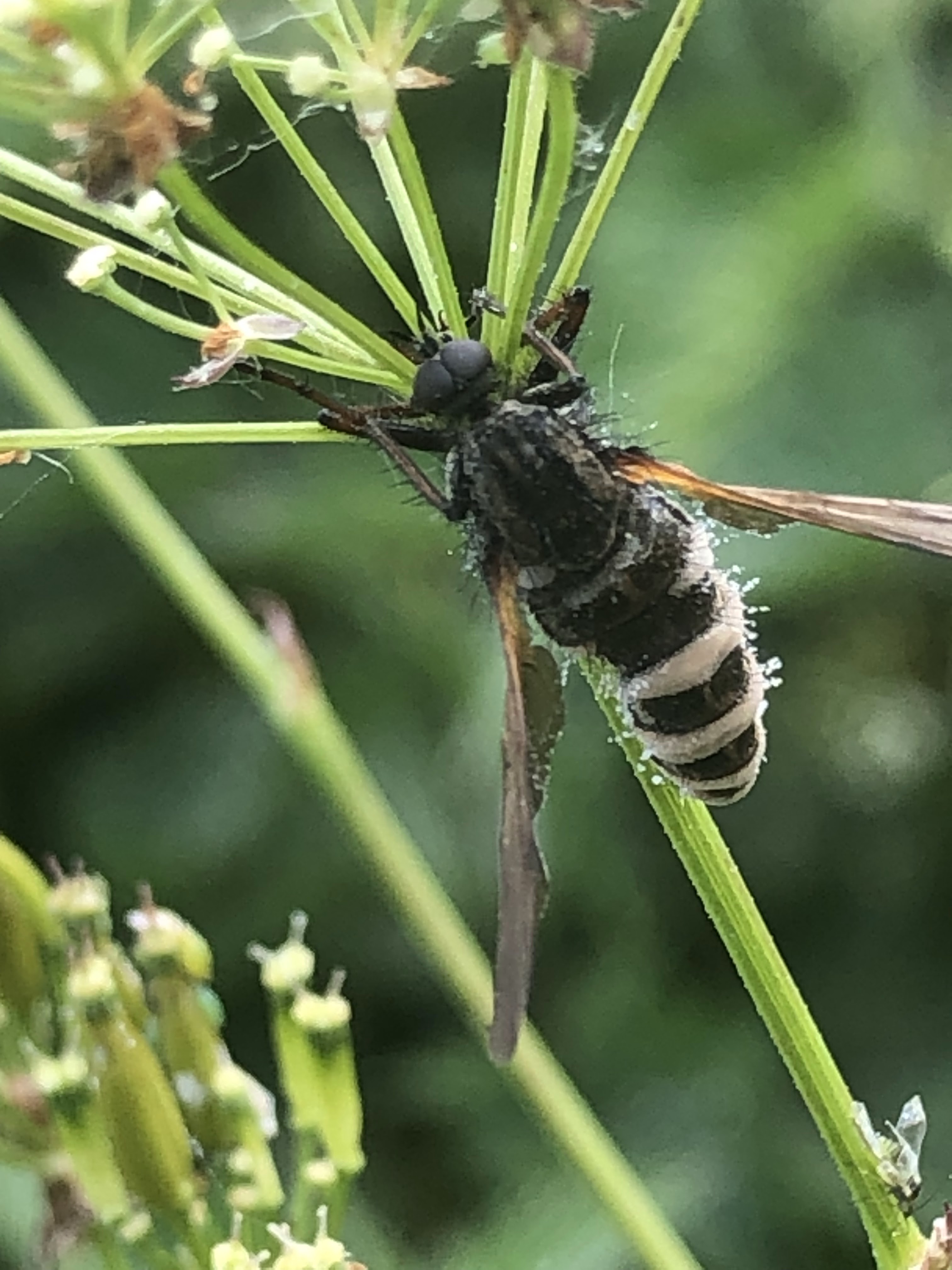
I was planning on writing about the abundance of Scarce Chasers on my patch. These dragonflies are… well scarce but seem to be doing well on my patch where we seem to be on the northern edge of their range for the river Avon. I was watching a male hunting over the meadow hoping to see it catch something and then photography it with its prey when I noticed a strange fly or wasp. It had an elongated white and black abdomen but fly like eyes. I took a quick snap of the individual hoping to ID it later.

I finished my weekly survey and stopped at the local pub for a soft drink and then had a look at the images I had taken. Superficially it looked like a fly, not your average bluebottle or flesh fly, I mused as to whether it was a solitary wasp, but no ovipositior and assumed it was one of the many thousand species of fly, perhaps a robber fly? That would be interesting, robber flies have an interesting ecology. Not having any books on flies and aware that my insect books wouldn’t have too many flies in them, I opted for AI.


Artificial Intelligence and machine learning are powerful tools but with great power comes great responsibility and one must always understand the limitations and problems in their use. Any AI derived identification must be crosschecked with reliable sources. I use the Merlin Bird Song App, its great but occasionally throws up a strange species, if I am at all suspicious, I will only record that species if I then subsequently see it and confirm it.

The AI I used this time was Google Lens, a subscription image search function of google that I had been using to ID plants and invertebrates. I use it mainly to point me in the general direction, perhaps to the family or genus level before diving deep into books or websites. In this case I uploaded the image and waited whilst the wheels turned. Shortly it had an answer for me, it had a few but number one was weird. It thought what I was looking at was a fungus. It was clearly a fly; it was clearly wrong. So, I uploaded another image and again it came up with a fungus. I did it to a third image and again the AI model found for me a fungus.

It wasn’t just any fungus, it was the same fungus each time, and the images it showed did look similar to my image, so I read a little deeper. The fungus was Entomophthora muscae. Interesting the term muscae relates in Latin to house flies. Entomophthora is also known as the Fly Death Fungus and is a pathogenic fungus focused on various fly species. Fascinating.

I started to research a bit more and discovered that Entomophthora have a unique life cycle. They require a fly host to live. Infectious spores land on a fly and penetrate their skin and enter the flies basic blood system known as haemolymph. Here the spores form cell-wall-less (protoplastic) cells within the body cavity. They use up the body’s fats and other nutrients to survive. Once it has drained the fly it has two options, if it was too quick and the fly dies the cells turn into resting spores remaining in the decaying carcass or if the fly is still alive it hijacks the fly causing its behaviour to change. The fly will move to a higher position where the fungus produces a mass of fruiting bodies called conidia that burst from between the segments of the fly’s abdomen, hence the striking black and white markings I saw. These conidia then spread spores that hopefully land on a passing fly and the infection starts all over again.

See at bottom to reference to the paper this was taken from.

On closer examination it was clear that the white parts of the abdomen were a non-fly related mass, and it was possible to see the fungal structures. The zombie nature of fungi is not unknown and is quite topical with the release of the second season of the Last of Us which revolves around a human infection of the Cordyceps fungus (something that Entomophthora does not do, it is only focused on flies). Cordyceps fungi infect a range of insects such as ants and control its behaviour to improve the chances of infecting another host. This turns its hosts into a kind of zombie unable to fight against the fungal mind control.

Entomophthora promote a series of behaviours that is known as “summit disease”. The stricken fly immediately seeks elevated locations. If it is too weak to fly it will climb. At the top of a plant or object it will cease moving. Its legs will grip the surface. Its proboscis will extend, and a droplet of liquid will be exuded that sticks the fly to the surface ensuring it cannot be dislodged or fall. Next the wings will raise and spread out and its limbs will straighten; death usually occurs then. Secure and high the fungus now releases it spores that can then rain down on any flies beneath them. The full cycle lasts between 5-7 days

There are about 22 species of Entomophthora that infect 8 families of flies including Mosquitos, Hoverflies, House Flies, Fruit Flies and Flesh Flies. They are most active in May and June and September and October. So keep an eye out for Zombie flies being controlled by fungi.

For more information,

Carolyn Elya and Henrik H De Fine Licht (2021) The genus Entomophthora: bringing the insect destroyers into the twenty-first century. IMA Fungus 12 (1) DOI:10.1186/s43008-021-00084-w


Sunday, 30 March 2025

NSFW Mallard Activity

Today is Mother’s Day in the UK and so it was somewhat apt that whilst birdwatching on my patch I observed the process of Mrs Mallard starting to become a mother herself. Mallard reproduction can be a somewhat brutal affair, they have a reputation for aggressive and violent mating. The ratio of males to females is often skewed towards the males and so when it comes to mating many males will target one female and will fight one another over the female and can drown the female in the process. 


Today’s mating was much gentler. The pair of Mallard had been feeding together for most of the morning, dabbling around the edge of the mill pond. The female broke away swimming away from the banks and signalling her intent by assuming a receptive posture. She bobbed her head a few times and then lowered her head on to the surface of the water, arching her back. The drake took little persuasion quickly grabbing her by the neck and mounting her. Normally this is where things become dangerous, by holding the nape and with the weight on the duck the copulation occurs with the female completely submerged. 


When other males are involved, the female can often be kept underwater by the throng and in the worst cases drown in the attempt. In this relationship it may appear that the female has a rough deal, and they certainly do, males will often force themselves on the female, however they have a trick up their sleeve.

The males have corkscrew shaped penises, which is unusual in the bird world where males generally lack external genitalia, that match anticlockwise vaginas in the female. Females can use muscles to restrict this anticlockwise passage and block the entrance of the male, this gives them some measure of control of who inseminates them. 

Today’s pairing appeared completely consensual with the female taking the lead once the mating finished, which lasted only a few seconds they separated  and began some vigorous washing and preening before hauling out on the bank for a nap.

Within the next 7-28 days if the female has allowed the semen into her vagina she will lay a clutch of  12-13 fertile eggs which themselves will hatch a further 28 days later. These ducklings will face an uphill struggle for survival for on my patch ducking mortality is very high. The number of pike, mink, otter, fox, and heron on this stretch that even if all 13 hatch only 1 or 2 will make it to adulthood.

Sunday, 16 March 2025

10-years Camera Trapping

 On the 31st December 2024 it was 10 years since I started recording wildlife using Trail Cameras on my patch. In those 10 years a camera in the same hedgerow has been recording 24 hours a day for 7 days a week.

Having finally made sure all the data is recorded in an Excel database I can now start to analyse the information, this is going to take sometime so I thought in the short term I would share some of the data that I have collected so far.

In the 10-years the camera recorded 3033 days, a total of  83% of the time, creating 19073 separate data points based on 10 minute blocks in which animals were recorded.


Percentage Active


No. 10 Min blocks


Mammal

Bird

Mammal

Bird

2015

78

78

40752

40752

2016

89

89

47088

47088

2017

76

76

39888

39888

2018

90

90

47088

47088

2019

84

84

44352

44352

2020

92

58

48672

30528

2021

80

80

41472

41472

2022

70

70

36576

36576

2023

76

76

40176

40176

2024

96

96

50688

50688


436752

418608


In total 51 Species were recorded, 31 bird species, 19 species of mammal and 1 reptile were recorded.


The most abundant species were Blackbird, Song Thrush, Woodpigeon, Wood Mouse, Grey Squirrel and Fox.

Taxa

Species

No. Blocks

Weighted

RAI K- Weighted

Bird

Blackbird

3595

3732

187.13

Bird

Song Thrush

1312

1339

67.14

Bird

Woodpigeon

691

937

46.98

Bird

Robin

743

750

37.61

Bird

Dunnock

422

450

22.56

Bird

Redwing

188

227

11.38

Bird

Magpie

180

188

9.43

Bird

Great Tit

156

164

8.22

Bird

Pheasant

115

126

6.32

Bird

Chaffinch

81

120

6.02

Bird

Wren

78

78

3.91

Bird

Jay

59

60

3.01

Bird

Goldfinch

22

25

1.25

Bird

Blue Tit

22

22

1.10

Bird

Bullfinch

19

21

1.05

Bird

Jackdaw

11

19

0.95

Bird

Woodcock

15

15

0.75

Bird

Water Rail

12

12

0.60

Bird

Treecreeper

11

11

0.55

Bird

Greenfinch

6

6

0.30

Bird

Moorhen

4

4

0.20

Bird

Blackcap

3

3

0.15

Bird

Stock Dove

3

3

0.15

Bird

Tawny Owl

3

3

0.15

Bird

Chiffchaff

2

2

0.10

Bird

Sparrowhawk

2

2

0.10

Bird

Carrion Crow

1

1

0.05

Bird

Great Spotted Woodpecker

1

1

0.05

Bird

Long-tailed Tit

1

1

0.05

Bird

Marsh Tit

1

1

0.05

Bird

Nuthatch

1

1

0.05

Mammal

Wood Mouse

3840

3960

198.57

Mammal

Grey Squirrel

2689

2737

137.24

Mammal

Fox

1656

1674

83.94

Mammal

Muntjac

1481

1622

81.33

Mammal

Badger

1166

1210

60.67

Mammal

Roe Deer

176

216

10.83

Mammal

Brown Rat

53

53

2.66

Mammal

Cat

39

39

1.96

Mammal

Rabbit

24

24

1.20

Mammal

Common Shrew

23

23

1.15

Mammal

Dog

21

21

1.05

Mammal

Weasel

20

20

1.00

Mammal

Field Vole

11

11

0.55

Mammal

Mink

3

3

0.15

Mammal

Bank Vole

1

1

0.05

Mammal

Hedgehog

1

1

0.05

Mammal

Mole

1

1

0.05

Mammal

Otter

1

1

0.05

Mammal

Polecat

1

1

0.05

Reptile

Grass Snake

1

1

0.05

18968

19943


Over the 10 years there have been some winner and some losers.


In the analysis I want to explore each species fortunes, calculate species richness, relative abundance, species diversity and evenness, similarity, niche overlap and do a deep dive on the activity cycles of all the species that I have enough data for.

This may take me the rest of this year!!