Monday, 14 March 2022

Spring is here

 The last few days have been gorgeous, today, in particular, was lovely and warm with clear blue skies. In the last week or so the snowdrops have given way to the daffodils and today I saw the first celandines in flower.

The willow trees are just coming into bud and today I pottered about my patch looking to increase the amount of wet woodland. The willows I planted a few years ago to thicken the wood have taken well and so I took 7 or 8 good branches about a metre long and pushed them into the soft ground to extend coverage across the front. It's very easy to propagate willows in this way, obviously, this is not a genetically diverse way of doing it but the premise of more to develop wet and fallen wood stock in the area, which in turn will be great for insects and subsequently birds.


With the high winds over the last winter a couple of the Alders are a little worse for wear and they do not seem to be being replaced in the stock. There are plenty of 20-30 and older Alders on my page along the backwater but I cannot think of a single young tree or sapling coming through. There are plenty of dead trees which the woodpeckers love but slowly they are falling (which I leave in place). I think this year I may buy and plant a few Alders if I can find a suitable stockist.

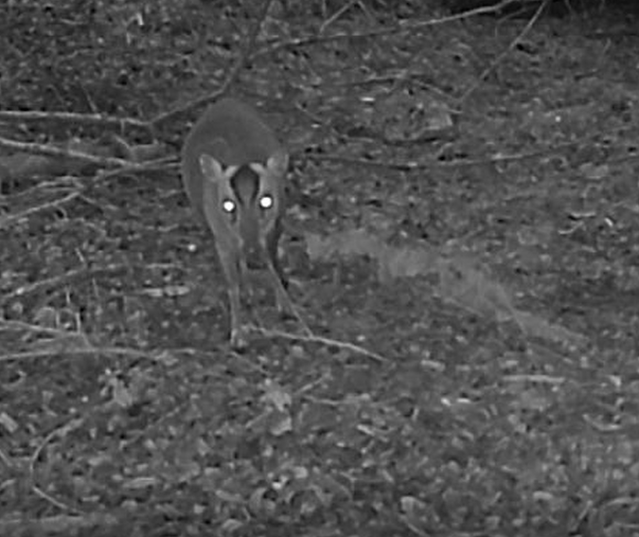
Moving away from the plants the Roe Deer were about again, just the usual three and I m constantly amazed at how quickly they can blend into the background. 

Given how mild the winter has been this year I was not expecting many of the winter visiting finches but this weekend saw several flocks of Siskin and Lesser Redpoll. The Redpoll were still on site today and I managed to get a shot of this handsome fellow.


There are still plenty of signs of Otter, in fact yesterday I found a new otter spraint in a very different location. I have noticed that the otters on otter cam like to climb on a fallen log and spraint there. When at the far end of the meadow I found a spraint a good metre off the ground on a horizontal branch.


In the first photo, you can see the distinctive fish scales and the second shows the branch on which it was left, quite a height off the ground. I m guessing that this stops and floodwater washing away the mark? I perhaps should have given it a smell just to check its origin, something to check out next time.

Tuesday, 15 February 2022

Roe Deer - A local success story

 At the outset of lockdown, I spent my 1 hour of exercise time down the mill on my patch and set up a camera on what I call the bridge. It was over these few weeks that I started to see more and more Roe Deer, in fact, it appeared that they had now become residents on the site.

The area is perfect for Roe Deer. I am used to seeing Roe Deer in woodlands. Around here I have only ever seen them in Warwick Castle Park when I was doing Heronry Census work. My patch is not heavily wooded but it does have a large stretch of scrubland that connects to the railway line. Railways are great conduits for deer to move along and why there are Muntjac in Priory Park in the middle of the town.

Throughout March 2020 I saw small herds of between 3 and 4 individuals some of which were picked up on my main camera. As you can see from the graph below this camera picked solo visits as early as 2015 but it was in 2020 that they started to be seen more regularly. The graph shows the trend as an index of Relative Abundance. This is a function of how many times a Deer is seen and in what number.


It shows a general increasing trend with 2020 being a particularly good year. In both 2020 and 2021, they bred on the site. 

At present, I most regularly see three individuals. An adult buck with antlers, a young male with only pedicles and a female.

The dominant buck is quite bold. The antlers are not fully grown yet, they can reach 30 cms in length and have up to three tines (points). Full-sized antlers do not grow until 3 years old, so it is possible this buck is around 2-3 years old.

Here you can see the Buck with his Antlers in Velvet in January

When not in velvet the full antler set will look like this.

The young buck is possibly last years kid, pedicles tend to develop at 3-4 months and his seem well developed but not enough yet to start growing antlers although these could be the start of his new regrowth

In this image, you can clearly see the 'buds' of new antlers coming through

Roe deer do not form large herds, they prefer small family units or to be solitary. I noticed that once the Kid is born the buck tends to not be seen with the Doe and Kid until the autumn when the family group seems to reform.

The female in the winter can be identified by the anal tush of hair,


The annual cycle as recorded by otter cam, which points across a well-liked rest area can be seen below. 


It shows that they are most active at that site in October, interestingly according to the literature this is the time of fewest reports however this I think is an artefact of using a Trail Cam rather than visual sightings. The distribution of sightings on this camera indicates that the deer are moving into and out of the area. The peak in July coincides with the rut.

Reproductively Roe Deer exhibit embryonic diapause meaning that although mating occurs in July/August the egg only implants in December. Therefore young are born in May/June when the vegetation is high and there is plenty of food. Twins is a common occurrence for Roe does but I have only recorded single kids. This could be because the habitat is sub-optimal or there is an element of postnatal predation from the foxes.

Using data from both the main cam and otter cam I have looked at when they appear most on camera. This graph indicates some level of activity but should be considered with caution.


The graph suggests that the deer are most active in mid-morning and mid-afternoon. This counters the literature that shows that their peak activity is at dawn and dusk. This difference can be explained when it is understood that both camera locations are in quiet well-covered areas. It is in these spots that the deer have chosen to rest up during the day. Whilst they may not rest or sleep, although that has been observed they do seem to like spending a lot of time just chilling there. They often spend between 30 mins to an hour quietly browsing or drinking.

Roe Deer are very well camouflaged and more often than not they see me long before I see them. They are amazingly agile and can disappear into the undergrowth very quickly and for large animals, the largest in this area they do so remarkably well.


Sunday, 6 February 2022

Mammal Week

 Over the past week, I have had an extra camera out to view small mammals. In just 7 days they recorded 10 species of mammal with several particularly good shots of the Roe Deer more of which to follow in subsequent posts.

All that was missing were the very rare occurrences of the Weasel and Mink. The site has also recorded Mole, Hedgehog, Rabbit, Stoat and Polecat although most of these have only ever been seen once.

Badger


Roe Deer


Muntjac


Grey Squirrel

Otter


Fox


Wood Mouse


Bank Vole


Common Shrew


Sunday, 16 January 2022

Oakmoss Lichen

 One of the pleasures of patch watching is that you can always turn up something new. You become so familiar with the area that new arrivals stand out. In this case today I noticed a species that must have been here for years. Whilst finishing off my walk this morning I noticed a vibrant light/white green lichen on a branch. Many of the trees are covered in lichens of different types and colours but this one caught my eye. 

It was on a dead branch jutting out at eye level and its bright colour and shape made it stand out. It looked fresh and new, like it had just grown there today. No wind nor rain had sullied it. It was intact and strong, each tendril intact and turgid.


I have a kind of Stockholm situation with lichen as a whole. They are a fascinating organism, part fungi, part algae living in symbiosis and I got my greatest education in them during my time at University. Between my 2nd and 3rd Years, I spent 10 days in the Burren in Western Ireland studying Mosses, Fungi and Lichens. As an ornithologist and zoologist, I was never particularly fond of the less mobile species on the plant, and the ten days was tough to stay interested.

Despite my reticence, I came to appreciate them greatly. I know notice them whereas once they were ignored and I understand their growth forms and ecology There is a simple beauty to them and an elegance. The leafy structures are good indicators of clean air and they are important sources of essential oils and other chemicals.

This particular lichen appears to be the Oakmoss Lichen - Evernia prunastri. This species is not an uncommon one and grows readily on trees. In France, it is harvested for its perfume fixatives and in Italy, it is grown as a bio-monitor  to analyse bioaccumulation of heavy metals.


Friday, 14 January 2022

My Field Kit


For the first post this year I m going to explain my day to day field equipment.

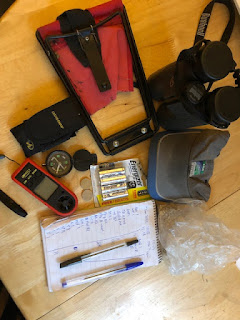
This is the list of things that I have in my field kit that I take out whenever I go out surveying or wildlife watching.

I have two bags that go out with me. The main bag has my binoculars, I would love to have a pair of Swarovski but I find my current pair Bushnell 10x40 more than up to the job. They are a great little pair, perfectly weighted and with good optics for the price.

I always ensure I have a notebook and something to write with. Ideally, a good fieldworker would use a pencil but I manage with pens as long as I don’t get it wet.


For comfort’s sake, I have a small fold away stool in case I want a rest or  I am staking out a location. To help with taking records for my weekly patch survey I have a wind speed and temperature centre and spare batteries for it. It’s a simple bit of kit and only cost about £30. I have a compass to check windspeed.

I find a leatherman multi-tool useful to have. Its range of tools helps clear back twigs or bushes from a camera line of sight or help fit trail cam mounts. To maintain my trail cameras I try to carry replacement batteries for them as well as spare SDHC cards.

Lastly, my main bit of kit is a cap, I find this useful for shielding my eyes from the sun or rain and is very flexible.

In my second bag, I carry my Canon Camera with 100-400mm lens that I use to shoot wildlife.

I prefer to shoot from the hand but I do have a tripod that I occasionally use.

This kit keeps me mobile and well equipped for nearly all my needs.


Sunday, 26 December 2021

Intersections

The last few weeks down the mill have been somewhat dull. The weather has been on the whole uninspiring and there have been very few winter arrivals and I am missing the summer visitors. There is a form of stillness hanging in the air most days and the wildlife, like most of the population seemed to be hiding away.

I often wonder what it is about being in nature that I find so appealing. On the whole, this feeling is ineffable but there are elements that can be teased out. One element is that of chance. I am not a twitcher by nature nor do I have the patience for sitting for long hours staking out the animal in question instead I rely on happenstance.

The chance encounters I make with wildlife were exemplified today as I made my weekly rounds. Much of my patch was flooded and the water too deep for my wellingtons. As I patrolled the bankside, walking stealthily so as not to surprise any Teal I came across a Fox.


I was standing on the bank watching the swirling water when down the slope on the other bank a rather large healthy fox totted. He spotted me about the same time I spotted him and the two of us regarded each other a moment. I considered the likelihood of this encounter, we each live different lives and our separate paths had intersected on this riverbank at this time. Had I been a few minutes earlier or later, or the water just a few centimetres higher then we would never have met.

What was Mr Fox doing I wondered, I doubted it was hunting for a start the gait was quite sedate and his posture did not strike me as hungry. Additionally, the small birds around us both seemed at ease with him. I have seen many foxes in my time and the Great Tits and Blue Tits make a very distinct sound when alarmed by a fox, it’s very different in tone and speed to the threat of a Sparrowhawk. On the whole, they seem to be aware of when a fox is predating and not just passing by. Like me, the Fox was out patrolling his territory and today our paths coincided.

A second encounter occurred some twenty minutes later when further upriver on my patch I spotted the electric blue of a Kingfisher’s back sat in a bush. Like the fox, it wasn’t particularly bothered by me and allowed me to take a seat and watch as it tried to fish in the silt swollen river. Another intersection of happenstance. The Kingfisher doesn’t normally fish on this stretch preferring a quieter stretch with more trees but given the swollen river and the darkness of the water had adjusted itself to fish in the shallows where the river was not so fast.


My camera trapping exploits highlight how fragile these intersections with wildlife are. Last week I was 20 minutes later than the otter by the river and I missed the Roe Deer by a mere 5 minutes another day. Three minutes or twenty are as good as a day in these cases. One can imagine that all these animals go about their days in quiet disregard of each other and in particular me. Each time we cross paths is a moment of coincidence, of a myriad of factors. You never know which intersection you will get and that I guess is the appeal. I have been visiting my patch for nearly 20 years and it is these encounters that add the requisite excitement that holds my interest. 

Wednesday, 27 October 2021

A rare visitor comes to Warwick

 I can't believe so much time has gone by since the last time I posted. Life had been crazier than normal  and there is a lot of news to catch up on, especially about the otters. However today I had to comment on a life list tick that I got today.

Following a tip off I heard that a Hoopoe had been seen round the corner from me in a business park feeding on the lawn. It appeared in Monday and today I went down on the off chance it was still there.

I was in luck there were a handful of other birders, many with telephoto lenses and there the individual was. It was feeding, unconcernedly, on the lawn. When startled it would fly up to the roof of the buildings or flutter off to some trees behind before returning.


They are a fairly regular spring and autumn passage migrant brought up by errant winds from Spain and Portugal, however they rarely get further than the south coast. This individual should be heading south to Africa for the winter but winds over the weekend have pushed it northwards, a change in the weather at the end of the week should push it on its way.

It seemed to be taking good advantage of its stay by feeding up on all manner of grubs in the grass. I was also lucky enough to see it flare its head crest.

The weather was a little dull and so the photo isn't the best but that was besides the point. It was fascinating to watch it probing the earth and the way it flew with a slight undulation. I was just as pleased with the people around. As I watched more and more birders appeared until there were 10 or 12, they had come from the north of the county and further afield like Gloucester. They all treated the bird with respect and kept a suitable distance. This was how twitching should be done, enjoying the bird in a relaxed way and it was greater to meet up with like minded birders and exchange stories.