Saturday, 3 February 2024
Pelagic Publishing - A Book Review
Friday, 5 January 2024
Water Water Everywhere!
As was alluded to in the last post there has been a degree of flooding, and by degree, I mean a lot. There is always some winter flooding in January and December but this New Year it was exceptional. Floods and storm events can often characterised by their frequency the last time the river rose this much was in perhaps 1998, making this a once-in-25-year flood event.
This therefore is the largest flood in the time that I have been managing my patch. Flood water before New Year had already brought down a holly-weakened Alder and flattened my northern fence. This time the extent was much worse.
I haven't been able to check on Otter Cam there is no way I can get anywhere near its location and given the height, the river rose to I am fairly sure the camera is no more. It rose so far that even the main cam was interrupted, it stopped recording on the 2nd January when the deluge reached its peak. You can see how the river rose in the following time-lapse video below.
| Main Camera location showing much of the top soil stripped off revealing the stony base and the debris left by the floodwater. |
To put it in context the camera is located over 80 metres from the main river channel. To look at the situation in more detail I did a little analysis on QGIS starting with a Digital Elevation Model of the area. This shows the height of the terrain from sea-level in meters. I would have preferred a more fine-grained set of data, perhaps height in 25 centimeters but beggars can't be choosers.
My patch runs along the main river channel which I believe is deeper than is shown here. It was canalised and actually runs higher than the backwater shown. The backwater is I think the original river channel that was diverted to feed the mill. Normally flooding barely reaches the hedgeline where the Main Cam is. Otter Cam whilst closer to the backwater and river is actually on a tree at least 1.5 metres up, unfortunately I think the river rose more.
I used the DEM to create a profile across the river showing the normal water level and what looks like to be the height of the flood water on the 2nd January.
![]() |
| Patch Profile over 140m - Showing normal water height in the river (far left) and back water (centre). The hedgeline with the main camera is on the far right. |
![]() |
| Estimated Flood Level - 140m cross section |
So what does this mean for the wildlife? Well, it has thrown up one interesting fact. Normally the dominant rodent recorded on the camera is the Wood Mouse with the very rare sighting of a Field Vole. This is because the vole prefers more undergrowth than is present where the camera is, but when the water rose more voles were recorded as the water drove them from the vegetation and up the bankside.
|
Date |
Number of
Wood Mice Recorded |
Number of Field
Voles Recorded |
|
28th
December 2023 |
14 |
0 |
|
29th
December 2023 |
29 |
3 |
|
30th
December 2023 |
4 |
4 |
|
31st
December 2023 |
4 |
0 |
|
1st
January 2024 |
6 |
1 |
|
2nd
January 2024 |
3 |
0 |
This devastation of my camera trapping will allow me to reassess how to move forward with the research and think about what cameras I will use and where. In some ways, this could prove costly but not as costly as it has been for the Saxon Mill pub. It was flooded out, something that has happened many times before but this time it was exceptional, you can see in the following photo how high the water rose by looking at the wet stone mark on the wall beside the entrance to the Riverside Bar.
Monday, 1 January 2024
2023 - A patch round up
So another year has been and gone, they are really starting to add up now. I started patch recording in 2002 and started getting good data in 2004. It means that I can start to see trends and patterns.
I have so much data it takes time to process it all, it's taken me two days to process the Bird data from visits let alone my camera trail data. That project is on hold because Otter Cam is currently inaccessible due to flooding.
So how can I evaluate this year's recorded survey session on my patch, how about a series of numbers.
Number of Surveys: 49
Average length of survey: 77 minutes
Total time spent on the patch: 60.5 hours
In that time I recorded:
63 species of bird bringing my patch total to 93 species.
4 species of mammal
12 species of dragonfly
15 species of butterfly
![]() |
| Number of Bird Species each month |
![]() |
| Number of Bird Species each year |
Highlights this year are obviously the new species spotted namely Firecrest, Red Kite, and Great White Egret.
Sunday, 10 December 2023
A Grey Squirrel thats a night owl?
I am writing this blog post on a very wet Sunday afternoon. I have been lacking inspiration to post for a while now. No special creature has appeared no profound thought of ecological theory has struck. I have very much been struck in the rut of the change of seasons, the summer visitors have gone, and the winter ones seem not to be bothering to come at all this year. Last week the temperature did take somewhat of a dive, and this resulted in the return of the Marsh Tits to my patch, a small flock of Teal, a nice view of some Goosander, and a very fleeting view of an accidentally flushed Woodcock.
This past week the cold has
evaporated to be replaced by rain, torrential downpours. Facebook happily reminded
me that 6 years ago today we were under 6 inches of snow what a difference. I
did see my first Redwings of the year, just three not the hundreds one would
expect. From this introduction, you may assume that I am going to wax lyrical
about climate change and the shifting of the season, but I feel I have done a
lot of that already and I would imagine that most of my readers are not climate
deniers. Instead, what piqued my interest were a few still shots from my main
camera trap.
This particular camera trap has
been situated in the same hedgerow recording 24/7 since 2015. This is my magnum
opus, my long-term contribution to wildlife, and in particular mammal
recording. My usual focus is on the Badgers, the local clan is seen less and
less (I am very worried about them at present), but more recently the Roe Deer
family and Otters have drawn my focus more. What has intrigued me most this
week however is the ubiquitous Grey Squirrel.
Laying aside the obvious debate
concerning its status as an invasive species, the demonic species that has devastated
the native Red Squirrel, even though it is just doing its thing…survival, what
drew my attention was some interesting behaviour.
It is easy to watch wildlife and become
focused on the individual, websites, and books are filled with portraitures of
birds and animals, and whilst delightful, I think I find the behaviour to be extra
interesting. We are now into December and like I said we have had a cold snap
now followed by rain. On the trail camera, I caught a few stills of a Grey
Squirrel collecting leaves, it was noteworthy enough to add it… well to the notes
section of my records.
Consistently for approximately an hour on the 28th of November in the early afternoon, a squirrel could be seen collecting beech leaves and taking them up the tree. This continued across the 7th, 8th and 9th of December despite the rain. This is obviously evidence that the individual is either building or remodelling its drey.
Squirrels live in dreys, collections
of leaves and twigs sometimes lined with grass and moss. They are not a species
that hibernate, and, in the winter, it provides, a warm refuge to retreat to
between foraging expeditions. Dreys are built in the crook or v of branches in trees
2-20 metres off the ground, they appear roundish and nest-like, in fact, they can
be confused with magpie nests although magpies are much messier.
![]() |
| Photo care of Rosser1954 on Wikimedia Commons CC-3.0 Grey Squirrel Drey.jpg |
What interested me however was the timing of this event. I understand building it now, the weather has turned and the squirrel needs to shore up its existing drey or repair its old one if conditions are likely to worsen but this squirrel seems to be in quite a hurry often working in the night!
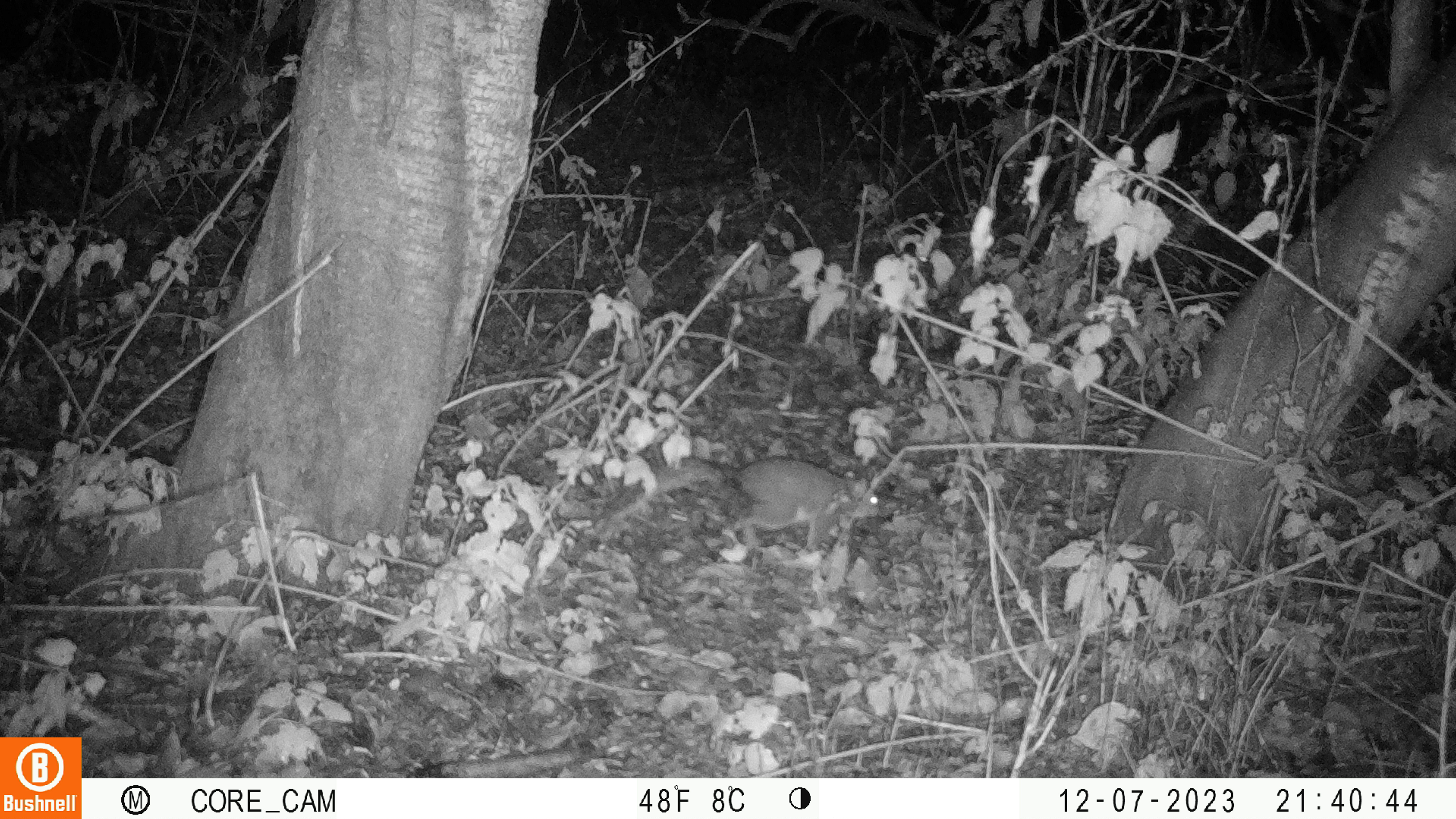
Squirrels are pretty much diurnal perhaps more active at dawn and dusk. Previous analysis of activity has indicated a rather broad daytime activity pattern on my patch. An aggregated count from 2015-2019 indicates activity occurring between 7 am and just past 5 pm so it surprised me to record the squirrel actively collecting leaves at 2.18 am, 5.40 am, 9.40 pm and 10.29 pm.
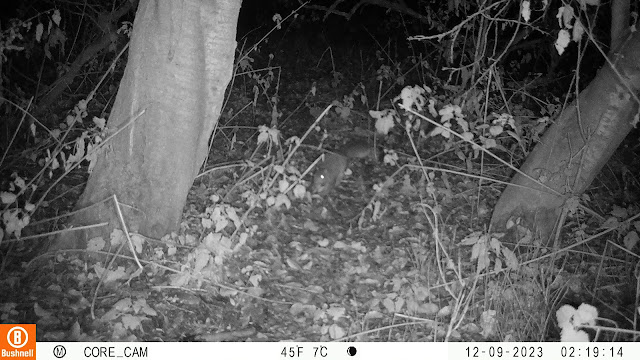
| 2.19 am and still collecting leaves! |
A quick internet search suggests that squirrels are not nocturnal however I am one who on the whole eschews the internet as the font of all knowledge and so have fallen back on my books. My go-to bible in these situations is Harris and Yalden’s Mammals of the British Isles: Handbook, 4th Edition.
The Grey Squirrel account is
written by J. Gurnell, R.E. Kenward, H. Pepper and P.W.W. Lurz and only has a
paragraph on activity in which it states that they are less arboreal than Red Squirrels.
Of note is a section on communication and senses. Seeing the squirrel in the
dark I was concerned for its safety. It is predated by stoats, buzzards, and
foxes. I have seen a vixen carrying a squirrel back to its litter, given that
its usual life strategy is based on daytime activity just how vulnerable was
this squirrel? The answer it appears is very, the book details the structure of
the eye drawing the conclusion that the species can see in up to dim-light so
fully nocturnal activity is very risky. Admittedly they have excellent hearing
but their agility on the ground and up trees is based very much on vision.
I then considered the effect of the moon; a full moon could give enough light for the squirrel however from the 7th-9th of December the moon was a waning crescent with only 24% illumination on the 7th falling to just 10% on the 9th.
I will not get a definitive
answer to this conundrum, nature does what nature does and most certainly does
not follow the rules of the textbook. I considered that the individual could be
pregnant and was forced to build/improve the drey for that, and births have
been recorded right up until the end of November. Perhaps the mild spell
allowed for a late pregnancy, but this is very much on the edge.
Animal behaviour is very much a
cost/benefit game, and this squirrel obviously felt the need to put itself at
risk and it would not do this if not for gain, unless this is one of those
individuals that shape evolution, either making a mistake that inevitably leads
to its predation and the end of its gene line or the pioneer that stakes out a
new niche for all its kind.
It are these puzzles that make
ecology such a fascinating topic to study.
Sunday, 3 September 2023
September Vlog
This week I experimented with doing a vlog of my patch. A look at what is about and what is happening at this time of year.
Monday, 7 August 2023
Rewilding and Conservation
![]() |
I am a little late to the debate stirred up by Alan Titchmarsh’s
comments on rewilding. This is in part because I wasn’t fully aware of what he said
and secondly, I needed time to collect my thoughts.
I first really encountered rewilding as a conservation
technique or at least a progressive form of land management back in 2013 when I
read George Monbiot’s book – ‘Feral’. I had been aware of the principle and had
heard of interesting results in Yellowstone regarding wolves, but this was the
first time I really began to delve deeply.
I am going to assume you know the principles of rewilding in
this article as that will make things a little smoother, but to set the stage, rewilding
is, in essence, letting ‘mother nature’ assert herself over previously
man-controlled habitats.
Now it’s true that in most of the world and indeed Britain
there is very little which has not been affected or changed by man. Even in the
remote wilds, powerlines and litter can be spotted or planes flying above. Man
of course is a part of nature like any other species, that however is a whole
other philosophical debate. The question then becomes what are we rewilding to?
The consensus is restoring habitats to a prehuman state say Ice Age. For Britain,
that means a lot of woodland and previously extinct mammals such as the beaver,
aurochs, lynx, wolves, and bears.
Let’s take a pause and look at what the argument was. Alan Titchmarsh
was lambasted for stating to a House of Lords committee that rewilding is “catastrophic”
for biodiversity and an “ill-considered trend”. What cheek! Alan has long
graced our screens and has supported wildlife gardening in many cases. His worst
crime however came from his ‘Ground force’ days which paved the way, pun intended,
for gardens that did away with lawns and encouraged everyday gardeners to hard
landscape.
The issue at hand here is scale, Alan was talking about the
idea of rewilding gardens. Letting the grass grow long, leaving some nettles
putting in a pond rather than a water feature. These elements are not rewilding
they are wildlife gardening. The two have become conflated. Rewilding, natural
rewilding in which land is left to regenerate itself needs space and lots of
it. Only with a vast amount of space can ecosystems develop into a natural mosaic.
For example, allow a meadow full of wildflowers to regenerate and it will first
become scrub and then woodland. During this time its biodiversity will change,
probably dropping before rising again. The grassland specialists will be
replaced by woodland ones. If the area is large enough and there are enough
ecosystem engineers then the grassland will regenerate in a new location,
perhaps becoming ephemeral. This is the principle of succession, the way in
which habitats evolve from bare rock to rainforests.
So, scale is important, gardens are just not big enough to
make rewilding possible. I am not saying gardens are beacons of biodiversity.
Non-native planting may be pretty, but they are not suitable for our
pollinators or insects, but they are better than a concrete wasteland. A bit of
wildlife gardening in each garden is a huge wealth of nature.
Part of the problem of rewilding is this concept of scale,
there are very few places in the UK where projects of suitable scale are viable,
the real problem of nature conservation is the limitations of reserves. I m not
saying nature reserves are bad per se just that over the years they have become
a limiting factor. We now have a series of isolated reserves across the country
that exemplify and protect particular habitats. By their very necessity, they
are managed. They are kept at what is termed in successional terms a
plagioclimax a stable state of equilibrium that reflects the particular habitat
or species that is desired. This is the
antithesis of rewilding; mother nature is put in halters. We have had to do
this to protect rare habitats and species, but how is that working out? Reserves
are sacrosanct but reflect only a tiny portion of the outdoor space and this
reflection is limited. What about the less interesting habitats or less interesting
species? Take, for instance, the House Sparrow or Starling, once common and now
in severe decline. We are lucky in Warwick with strong numbers of both (though
much fewer than in my youth) but where are their reserves and protected spaces?
This is an extreme example, but I think you catch my drift.
Scattered reserves are fragile and vulnerable, cursory examination of Ilka
Hanski’s metapopulation and habitat fragmentation theories catalogue this. Recent
actions have been to connect reserves and work at the landscape scale, but this
brings conservation into even more conflict with landowners and planners. Good
work is being done by Warwickshire Wildlife Trust with the Princethorpe Woods
Project and the networks in the Tame Valley, but we need more. More protection
and sympathetic management across the countryside. Even the lowliest patch of
scrub or nettle bed holds a level of local importance and by focusing on the
special we risk dragging the common down to the lower level rather than raising
them up. Rewilding plays a part in this, as with these larger networks and landscape-level
approaches there is more opportunity to allow habitats to shift naturally to its
successional apex.
In many respects, many reserves are examples of controlled
rewilding. Over one-third of the reserves managed by Warwickshire Wildlife
Trust are reclaimed industrial land. Mostly quarries, gravel pits, and railway
cuttings. These sites are ripe for development and allow a habitat to be chosen
and cultivated. They are flagships for renovating old sites and have worked
considerably well but often tend to be wetland sites, good for visitors and
waterfowl, however what of our farmland birds? Should more farmland not be
bought and managed? The trust manages many excellent ancient and semi-natural
woodlands and these are great but are part of the landscape, we need to secure
the sections in between not just the connecting hedges.
This has turned into somewhat of a ramble but at the root of
it is that nature conservation has to evolve. Reserves are a useful start;
rewilding is a great tool but neither is good in isolation. Pundits like Alan
Titchmarsh are not ecologists, and they have a vested interest in a particular
narrative, we can’t blame a gardener for advocating for neat cut lawns and
flowery beds, but we need to take direction from those that know not who say
they know.
With climate change and the biodiversity crisis, I feel that
we are at a crossroads. There is a need, as biodiversity offsetting takes hold
and the pressures of house building increases, to start to focus on the
strategic and landscape scale to protect all habitats not just the rare ones.
Sunday, 9 July 2023
The Canary, the Butterfly and the Licence Plate - The decline of insects
I have spent just under half my life visiting and recording wildlife on my patch, that’s quite a chunk of my time, about 20 years to be truthful. I am someone who likes routine, but this is more than that. This is a piece of land that I love and am in sync with. I have seen enough now to be in tune with some of nature’s cycles and realise when something is off. Some people may get bored with visiting just one spot, in fact, many birders or twitchers chase the dream birds, would I do that if I enjoyed traveling… I think not. There is something special about becoming part of an ecosystem and understanding its ebbs and flows. Besides the site continues to amaze and surprise me.
![]() |
| Marbled White |
Just today I was out for my normal Sunday morning visit having lamented the previous week’s lack of butterflies. Last year the farmer cut the meadow and I had predicted to myself that the loss of many of the nettle beds and more grass would result in fewer tortoiseshells but more ringlets, meadow browns, skippers, and gatekeepers. So far, this vision had not been borne out. I was beginning to think about the national insect decline. This is a national crisis affecting all of Britain. Invertebrates are an essential pillar in our habitats. They provide the bulk of the food for our nesting birds and breeding fish which in turn provide for our predators. How can we expect our declining Swifts to survive if not only are we robbing them of their nesting spaces but their very food?
To highlight this problem, I had a mini epiphany this week.
It is early July and Wimbledon is in full swing. When I was a child in the late
1980s my sister and I would watch some of the matches but more often we had
more fun playing our own Wimbledon in the back garden. Mum would string some
wool across the garden to act as a net and we would come out on to centre court
with our plastic blue rackets and our bright yellow or red sponge balls to play
a few games, complete with MacEnroe-style debates regarding what was in or out
and who was serious.
One of the key features of these games were the clouds of midges
that seemed to hang in the air at the bottom of the garden. These were not the Scottish
midges that would eat you alive but more the tiny non-descript tiny flies that
as a species seemed to serve no purpose except to annoy. We would take great
delight in swiping our rackets at them, imagining we were decimating their
numbers like mighty warriors when in fact I doubt we ever struck one, so large
were the holes in our rackets and the air pressure created. The point is that
when I look at the bottom of the garden now, I find it hard to see a single
simple fly. We have insects, bees, wasps other flies but in much smaller
numbers. We have never used insecticides and our garden is wildlife-friendly
with overgrown patches and an adequate pond so it’s not a change in the very
local habitat but something wider, something national, something global.
Buglife has been assessing this problem and has just (June) released
its 2023 Bugsplat survey. This innovative survey assesses the number of insects
that get squashed on a number plate across a certain distance driven. This is
of course a citizen science project and as such have inherent flaws in the
distribution of responses. Scientifically comparing long-term trends, I wonder whether
there is an effect on the change in car design and aerodynamics that might affect
the data, but that’s just my analytical scientific brain working overtime. The
survey now, digitized via an app, aren’t they all these days, demonstrates that
the number of insects sampled on a licence plate between 2004 and 2022 is down
64%. This value backs up the more anecdotal evidence and something that for me
is an observation.
Luckily my patch continues to surprise me. With most of July
and August still to go it is hard for me to assess if butterfly numbers are
down on my patch, but today’s survey was encouraging. The survey was done this
morning following a night of rain with increasing sunshine and a light breeze,
within the hour I had seen 6 Ringlets, 3 Meadow Browns, 2 Red Admirals, 3
Commas, 1 Large Skipper, 31 Large Whites, and 1 Marbled White. The Marbled White
is particularly exciting. This has never been recorded at the Saxon Mill before,
in fact, I have only seen this species out towards Charlecote and Stratford way
in the past until this year, when I recorded one last week at Warwick
Racecourse.
So what is the moral of the story, two things, I do not
think I will ever get bored of my patch, it continually surprises and after 20
years I am still discovering new species, secondly, insects are suffering
and insects are not the only canary in the coal mine that has become choked on
the gases produced in the past few years.