I have to declare here and now that I am not a patient wildlife watcher. I find it hard to sit in one place and wait for the animal in question to appear I always become distracted by the other wildlife around me and before long I am off hunting that down rather than the intended species.
I am the kind of watcher who likes to go out and see what nature surprises me with, but even so there are a number of skills any guide book will tell you. Wear clothes that are comfortable and breakup your outline, approach from downwind and walk quietly. Try to arrive before the species and pick a good safe spot to watch from.
For me though there are some other points I would suggest. For these you are required to become part of your habitat. Understand where you are and take a few moments in silence to settle into the habitat, soak in the sounds. Sound is one of the most underrated sense in watching. I often hear an animal before I see it. Animals and birds all move with an element of regularity something that the wind doesn't. Natural features like wind are chaotic and without pattern animals are less chaotic they have a set or parameters and drives that mean that their signs are regular.
I remember learning in my Landscape Ecology lectures about energy flows in nature and in man made landscapes. Humans use energy to force elements in to unnatural patterns, take for example a fence or wall, these are straight linear features which do not occur in nature. Nature abhors pattern and thrives in chaos. You can use this to you advantage, animals like us follow established paths and have regular effects on their surroundings. Sitting quietly you can easily distinguish between a deer trotting through the undergrowth and the wind doing the same.
Still on sound do not forget to listen to the birds. They are excellent watchers and Blackbirds and Great Tits will see you from a mile off and have communicated that to the birds around them. Listen for this, changes in their calls will differentiate between foxes and sparrowhawks. I have used Great Tits many times to track down a top predator, Magpies are especially good for tracking down roosting Buzzards.
Animal especially British Animals are masters of camouflage and so I suggest that what you should look for is what they are looking for from you, the general shape. This is why it is best to crouch or sit low with your back to a fence, tree or wall, it breaks up your shape. Look instead for movement even the tiniest of movements.
Once you have found your species the deepest urge is to look at it. Animals, especially prey species find this very unsettling. In this case it is best not to suddenly twist your head and fix it with your gaze but instead to slowly turn, allow the animal to get used to you not being a threat. Do not make eye contact, this will often make the animal head for cover at a rate of knots. |Reduce all movements to slow gentle ones, avoid sudden movements.
These obvious tips have helped me get close to many different animals and be able to sit calmly in their presence. It all takes practice and I am nowhere near a master.
Monday, 6 May 2019

Sunday, 28 April 2019
Muntjac and Roe Deer multiplying
In the last few weeks I have been far too engrossed in my thesis to a) get out much and b) post to this blog, however the end is now in sight.
In this same time period I have moved my unsuccessful Otter cam to a series of other locations. I have had it at an undisclosed Badger Sett where I was lucky to record 3 cubs and more recently I have had the camera placed over an open piece of grassland and have been treated to some nice deer shots.
Muntjac have been a common sight on my patch for years and I have been lucky enough to see both young and adults. This week however I believe the clip shows a pregnant female judging by the extended belly.
Muntjac are able to breed all year round but this is definitely the season as a possibly pregnant Roe Deer was seen. This is exciting as Roe deer are recent residents to the site and the fact that they are breeding means that they are comfortable enough on the site.
A rather handsome buck has been seen as well which is good.

In this same time period I have moved my unsuccessful Otter cam to a series of other locations. I have had it at an undisclosed Badger Sett where I was lucky to record 3 cubs and more recently I have had the camera placed over an open piece of grassland and have been treated to some nice deer shots.
Muntjac have been a common sight on my patch for years and I have been lucky enough to see both young and adults. This week however I believe the clip shows a pregnant female judging by the extended belly.
Muntjac are able to breed all year round but this is definitely the season as a possibly pregnant Roe Deer was seen. This is exciting as Roe deer are recent residents to the site and the fact that they are breeding means that they are comfortable enough on the site.
A rather handsome buck has been seen as well which is good.

Sunday, 24 March 2019
The Grey Heron
This weeks post is a photo story about the Grey Heron. Heron are a common sight around Warwick. A sizeable Heronry exists in the town and so at this time of year Adults can be found all over the local waterways looking for food.
On Saturday a chance encounter led to a intimate connection with one of these prehistoric birds. A series of small brooks join the Avon, one of which runs near the canal aquaduct. This brook was gushing with water, swelled by overfill from the canal and in it I stumbled upon the Heron.

It was stood leg deep in the water, pacing along its edge. Normally Herons are very flighty. On my own patch they rarely allow you to get close than 15-20 metres but this individual was remarkably unconcerned. Looping around so as not to disturb it I paused on the bridge and unslung my camera.
The heron was well aware of my presence. They have amazing eyes. They are place on the sides of the head allowing for good all round vision but are able to twiddle them forward to give great binocular vision for the all important hunt.

Aside from myself several others came past and stopped to watch, each passer by elicited little more than a glance unless of course they had a dog, where the heron would become more agitated. It would gape its beak and extort a harsh croak.
After a short while, tired of fishing it flapped up onto a branch and proceeded begin a grooming cycle. This further reinforced how comfortable the bird was now barely 5 metres from me. It gave me a chance to watch as it bent its neck around to check the chest plumage and rearrange the feathers under the wing. It occasionally supplemented this with a scratch from one of the legs.

Such a comfortable close up gave me a chance to really explore the animal and focus on the eye and beak. The beak is a solid thing and you can see how its dagger shape is well suited to catching slippery and wriggling fish as well as hopping amphibians and scampering voles. As I mentioned before, the eyes are a sight to behold. There is something primitive and almost dinosaur like in their gaze. When you stare into the eyes of a heron you really can believe they evolved directly from the small theropod dinosaurs.

On Saturday a chance encounter led to a intimate connection with one of these prehistoric birds. A series of small brooks join the Avon, one of which runs near the canal aquaduct. This brook was gushing with water, swelled by overfill from the canal and in it I stumbled upon the Heron.

It was stood leg deep in the water, pacing along its edge. Normally Herons are very flighty. On my own patch they rarely allow you to get close than 15-20 metres but this individual was remarkably unconcerned. Looping around so as not to disturb it I paused on the bridge and unslung my camera.
The heron was well aware of my presence. They have amazing eyes. They are place on the sides of the head allowing for good all round vision but are able to twiddle them forward to give great binocular vision for the all important hunt.

Aside from myself several others came past and stopped to watch, each passer by elicited little more than a glance unless of course they had a dog, where the heron would become more agitated. It would gape its beak and extort a harsh croak.
After a short while, tired of fishing it flapped up onto a branch and proceeded begin a grooming cycle. This further reinforced how comfortable the bird was now barely 5 metres from me. It gave me a chance to watch as it bent its neck around to check the chest plumage and rearrange the feathers under the wing. It occasionally supplemented this with a scratch from one of the legs.

Such a comfortable close up gave me a chance to really explore the animal and focus on the eye and beak. The beak is a solid thing and you can see how its dagger shape is well suited to catching slippery and wriggling fish as well as hopping amphibians and scampering voles. As I mentioned before, the eyes are a sight to behold. There is something primitive and almost dinosaur like in their gaze. When you stare into the eyes of a heron you really can believe they evolved directly from the small theropod dinosaurs.

Sunday, 3 March 2019
Woodcock Camouflage
I have been so busy working on my Masters project that I have had little time to post on this blog.
I have continued to record sightings and collect camera trap data and so I am going to present today a few clips looking at Woodcock.
The Woodcock Scolopax rusticola is an infrequent winter visitor to my sight. It s mostly nocturnal and so gets picked up on my cameras. In 2018 it was seen on 8 occasions between January and March and this year over four days in January and February.
The Woodcock has a sensitive probing beak it uses to sniff out invertebrates, you can see this in a clip I took this week.
The last clip I want to show is also from this week and shows the woodcock in daylight. Note how the brown and black striping make the bird very cryptic and hard to see once it stops moving against the backdrop of the leaves.
I have continued to record sightings and collect camera trap data and so I am going to present today a few clips looking at Woodcock.
The Woodcock Scolopax rusticola is an infrequent winter visitor to my sight. It s mostly nocturnal and so gets picked up on my cameras. In 2018 it was seen on 8 occasions between January and March and this year over four days in January and February.
The Woodcock has a sensitive probing beak it uses to sniff out invertebrates, you can see this in a clip I took this week.
The last clip I want to show is also from this week and shows the woodcock in daylight. Note how the brown and black striping make the bird very cryptic and hard to see once it stops moving against the backdrop of the leaves.
Sunday, 20 January 2019
Molehills and Miscellany
The last few weeks since my flurry of Otter sightings have been the humdrum week to week norm. Unusually mild few new species have been recorded on my patch and the activity at my camera trap has been low.
Small flocks of Siskin have started to appear and Goldcrests have been more prevalent as have the Kingfishers. I was lucky enough to spot one this morning on the backwater fishing. It was the distinctive plop sound of a failed dive that caught my attention first. I was able to track him to the far bank and watch him for a few minutes before a pair of squabbling Little Grebe startled us both.

I am always astounded by the vibrant blues on the head and wings.
On a funny note I discovered another use for my trail cam. When I collected the card this morning I noticed a fresh molehill in the field of view. By running through the images I was able to identify when it appeared and was able to ascertain that the mole pushed up the spoil between 12:05pm and 4:06pm on Sat 19th Jan. The movement itself was obviously too slow to trigger the camera itself but it certainly adds incentive to my photo a mole project, more of which in a future post.


Small flocks of Siskin have started to appear and Goldcrests have been more prevalent as have the Kingfishers. I was lucky enough to spot one this morning on the backwater fishing. It was the distinctive plop sound of a failed dive that caught my attention first. I was able to track him to the far bank and watch him for a few minutes before a pair of squabbling Little Grebe startled us both.

I am always astounded by the vibrant blues on the head and wings.
On a funny note I discovered another use for my trail cam. When I collected the card this morning I noticed a fresh molehill in the field of view. By running through the images I was able to identify when it appeared and was able to ascertain that the mole pushed up the spoil between 12:05pm and 4:06pm on Sat 19th Jan. The movement itself was obviously too slow to trigger the camera itself but it certainly adds incentive to my photo a mole project, more of which in a future post.


Sunday, 6 January 2019
The Inner Life of Animals by Peter Wohlleben

One of my Christmas present last year was the delightful book, The Inner Life of Animals of a Hidden World by Peter Wohlleben. Having just completed it I thought I would give you a quick review.
The book is a charming collection of thoughts and musings on animal behaviour, much like this blog is. Over a series of 50 short chapters Peter explores the inner mind of animals. He tackles ideas on emotions animals feel, pain, loss. How intelligent species can be and what our relationship is with them,
He approaches our connection to nature in a pragmatic way acknowledging the use of some animals for food and others as being unsuitable. He questions certain assumptions and challenges anthropomorphism in a similar way that I do. He shows that animals have feelings and intellects as equally complex but it would be foolish to use our on experiences to judge theirs and in doing so believe we can understand their motivation. In fact if there is one single cohesive message in the book it is the analysis of the interplay between instinct and choice, and I m unsure Peter actually reaches a conclusion on which is supreme.
The book is easy to read. The perfect size for picking up and dipping into but with enough charm and joy to keep you turning the pages for hour after hour if desired. What made the book enjoyable for me was the setting. Peter is a land owner and forester in Germany and so the wildlife he includes is more diverse than our own. In effect the range of animals he relates to our what would once what Great Britain would have been had. The species mix is familiar enough not to be jarring and exotic enough to be enticing. It allows the book to be a journey into a new physical world as well as an inner mental one.
Some people may wish for a more scientific analysis of the mind of animals. Peter does evidence his work with some studies but most points come from anecdotes and personal experiences. This does not devalue his work at all, he is a knowledgeable and engaging guide to the wild and only a fool would not listen to someone of such experience and there are plenty of books out there with neurological diagrams and statistically tested conclusions but none of them will be written with the charm that Peter does.
Tuesday, 1 January 2019
2018 - A year in Review
Well there we go 2018 is gone and 2019 is upon us and what a year it was.
This year saw the completion of 15 years of surveys on my patch at the Saxon Mill. Sadly much of the year was lost when the bridge was taken out and left me unable to access the patch. I was able to get some access once work started and meant that I only lost 3 months survey data although this was the busiest time, summer, meaning my nest records, butterfly and dragonfly numbers were down.
Over the year I recorded only 49 species of birds, mainly due to me not being able to record the summer visitors, 2 butterfly species, 3 dragonfly species 3 mammal species and 1 reptile species. Of course the hands down highlight was the Otter sighting on my land in early December.
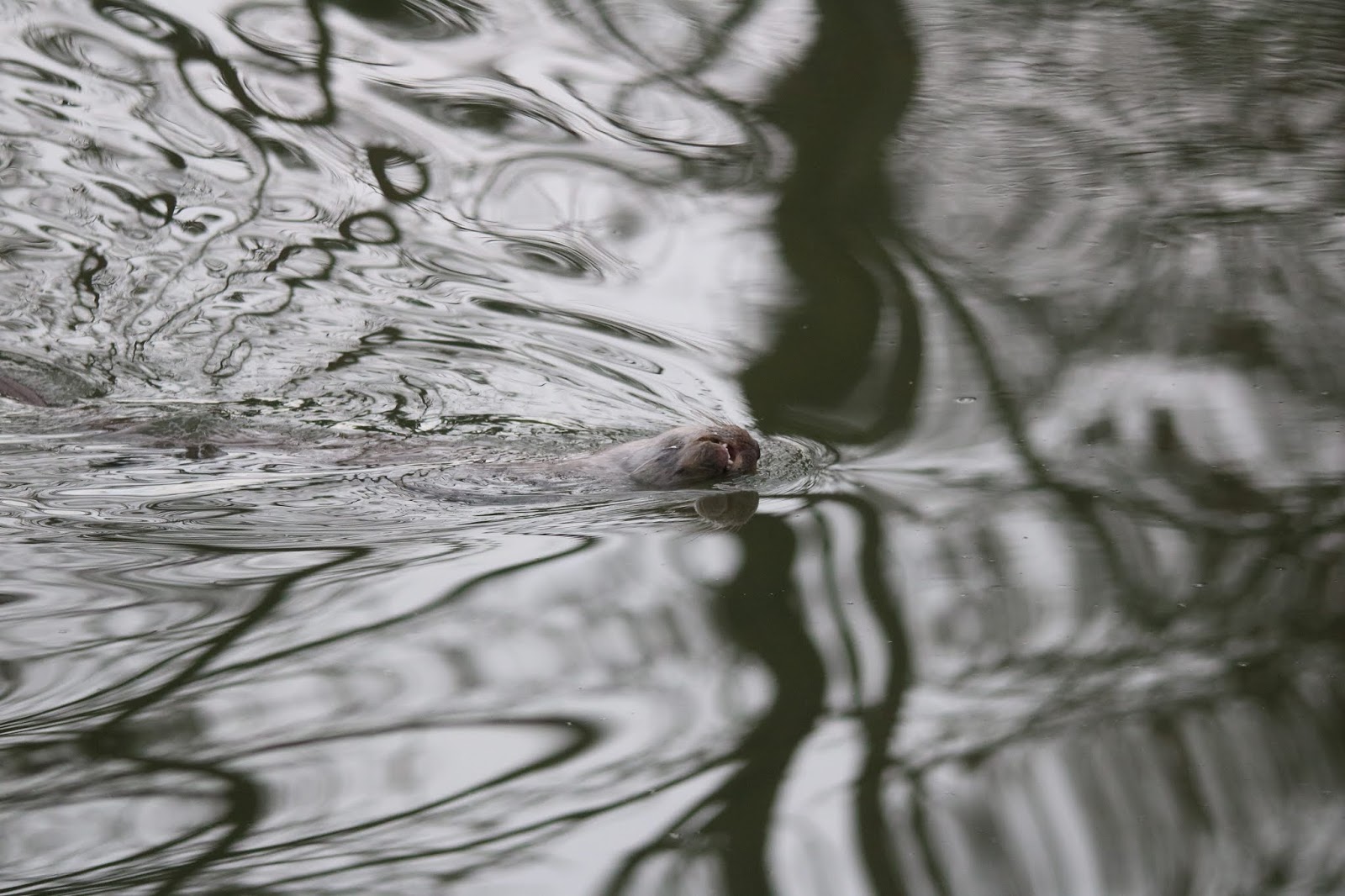
Speaking of which, talk about two coming along at the same time I saw a second otter on the Avon this time behind Tescos heading towards St Nicholas Park. This one stayed around a bit longer and I was able to really watch the movements and the way the bubbles leave a trail when it swam under water. This animal seemed smaller than the one I saw at the mill possibly a female or sub-adult. It was also more cautious of me.


On the 31st December my long term camera trap completed its first year in its new location. In its time it was activated 3328 times over the 12 months. New species to be recorded included the Hedgehog and Woodcock. In fact the woodcock was quite active early in the year.
The most frequent observation in order is:
430 - Fox. I now know there is a Juvenile, Half-Tail, No Tail and Full tail. 4 individuals using the site.
415 - Grey Squirrel
388 - Blackbird
246 - Wood Mouse
146 - Song Thrush
142 - Badger
121 - Muntjac
Most interesting in terms of camera sightings was watching the Fix Cub grow up and note the rise in Roe Deer being seen more frequently and in greater numbers.
In fact the most recent sighting was off a Buck with its horns just starting to grow.
Once I have had time to process the data pretty graphs will follow.
Here is hoping 2019 is going to be as exciting and rewarding.
This year saw the completion of 15 years of surveys on my patch at the Saxon Mill. Sadly much of the year was lost when the bridge was taken out and left me unable to access the patch. I was able to get some access once work started and meant that I only lost 3 months survey data although this was the busiest time, summer, meaning my nest records, butterfly and dragonfly numbers were down.
Over the year I recorded only 49 species of birds, mainly due to me not being able to record the summer visitors, 2 butterfly species, 3 dragonfly species 3 mammal species and 1 reptile species. Of course the hands down highlight was the Otter sighting on my land in early December.
Speaking of which, talk about two coming along at the same time I saw a second otter on the Avon this time behind Tescos heading towards St Nicholas Park. This one stayed around a bit longer and I was able to really watch the movements and the way the bubbles leave a trail when it swam under water. This animal seemed smaller than the one I saw at the mill possibly a female or sub-adult. It was also more cautious of me.

On the 31st December my long term camera trap completed its first year in its new location. In its time it was activated 3328 times over the 12 months. New species to be recorded included the Hedgehog and Woodcock. In fact the woodcock was quite active early in the year.
The most frequent observation in order is:
430 - Fox. I now know there is a Juvenile, Half-Tail, No Tail and Full tail. 4 individuals using the site.
415 - Grey Squirrel
388 - Blackbird
246 - Wood Mouse
146 - Song Thrush
142 - Badger
121 - Muntjac
Most interesting in terms of camera sightings was watching the Fix Cub grow up and note the rise in Roe Deer being seen more frequently and in greater numbers.
In fact the most recent sighting was off a Buck with its horns just starting to grow.
Once I have had time to process the data pretty graphs will follow.
Here is hoping 2019 is going to be as exciting and rewarding.
Subscribe to:
Posts (Atom)