Showing posts with label Birds. Show all posts

Saturday, 18 April 2026

An early feast

Today, whilst out birding, something caught my eye. I have started visiting Warwick Racecourse more often this past year, mainly to build up a species list for the site and to get some nice photographs of different birds. 


At this time of year, I am usually focused on the Skylarks and the returning warblers; however, today, what caught my eye first was a flock of Starlings. Starlings are not unusual on site. They are present all year round in small flocks, usually on the short turf by the football ground. Here they potter over the grass, looking for insects and probing for leatherjackets. Today, however, they were further over near the water channel. They sat along the fence line, some of them shooting into the air, hovering and then returning to the fence. If I couldn’t see directly that they were Starlings, I would have identified them as stocky flycatchers, twitching into the air, fluttering and returning to a perch. It was this odd behaviour and that thought of the flycatcher that held the answer. 

Taking a moment to look around me, I noticed that the air was filled with black flies. Flies are often a very overlooked taxon, unless they are flying around your food, but they are incredibly important ecologically. The flies I could see were familiar to me. 

They were jet black, some about an inch long. They floated in the air with their legs dangling, looking like some kind of drone. They seemed to bob on the air currents, settling occasionally on vegetation. These flies are known as St. Mark's Flies (Bibio marci) or the hawthorn fly. They are called St Mark’s flies because their emergence flight period usually coincides with St Mark’s saint day (25th April). 

Image from Warren Photography - https://www.warrenphotographic.co.uk/28027-st-marks-fly-in-flight

The fly is known for its spring appearance. Its larvae live in the soil, feeding on roots and decaying vegetation before pupating into their adult forms, which then take to the air, slowly drifting in swarms with their legs hanging down. This stage is short-lived, lasting perhaps a week as they search out a mate. During this week, they sustain themselves by feeding on the nectar of fruit trees and hawthorn flowers, making them important pollinators for these species. 

In many ways, this display of floating dancing flies is a terrestrial form of that exhibited by Mayflies over our rivers. These swarms form an important food source for many species. The Starlings had identified this and left their usual spot to take advantage of the glut of food.

It's one of nature's miracles, the ability of such tiny organisms to synchronise and emerge together. Sometimes it's the small things that reveal the most.

Monday, 16 February 2026

Ups and Downs for Raptors

 Birds of prey, as apex predators, are often used as indicators of ecosystem health. Their fortunes reflect changes lower down the food chain and can help us understand how other species are responding to wider environmental pressures.

 I have accumulated enough data over the years to begin exploring these dynamics more meaningfully. So, when I recently found myself musing that I seem to be seeing Peregrines far more often than I used to, I dug a little deeper and put that feeling into context. That thought was really the combination of two separate observations: first, a Peregrine perched on Guy’s Cliffe House, and secondly, how rare it has become for me to see Kestrels at all.

Peregrine

Raptors have had mixed fortunes in the UK, and their numbers have changed drastically within my lifetime. As a child, seeing a Buzzard in Warwickshire was a rarity; now they are ubiquitous, and it is the Red Kite that still feels like a novelty. Kestrels were once abundant; no car journey felt complete without spotting one of these wind-hoverers over the motorway. As for Peregrines, those required a special trip to places like Symonds Yat. Thirty years have passed since my childhood, so what does my local patch tell me about raptors and how they have changed?

After watching the Peregrine perched on the house for a while, I returned home and looked back over the data I’ve collected. I keep a master database spreadsheet that tracks frequency, numbers, and abundance for all bird species recorded. When comparing species, I use a relative abundance measure that weights sightings by the time spent in the field. This helps account for extraneous factors that can otherwise skew results. I plotted these values as a graph and added some contextual information.


I chose to look at all raptor species that have occurred on my site since 2004. Owls were excluded because my survey methodology substantially underestimates their numbers. When I first started recording, there were three main raptor species: Buzzard, Kestrel, and Sparrowhawk. This has since increased to five, with the addition of Red Kite and Peregrine.

 Buzzards have always been, and continue to be, the most abundant species. They are seen on practically every visit and, pleasingly, in 2024, they nested directly on the patch. Despite low rabbit numbers, their favoured prey, they continue to do well, raising two to three young locally. This mirrors the national picture, where Buzzards are now a stable and widespread species after expanding from their upland strongholds during the 1990s.

Sparrowhawk
 In contrast, Kestrels have undergone a serious decline over the same period and are now Amber-listed. The loss of rough grassland, agricultural intensification, and increased competition are all thought to be contributing factors. Locally, the decline was accelerated by a specific event. A tree in which a pair frequently nested was damaged when a winter storm in 2022 tore off the top of an Ash, exposing the nesting cavity. The loss of that single tree has had a noticeable effect on sightings. With low national numbers and no replacement pair moving in, the area has yet to be recolonised. Despite an abundant vole population in the meadow, I suspect this will remain the case for some time.

 Sparrowhawks are common across the site, as they are around the surrounding housing estates. They remain at a steady but relatively low abundance, which likely reflects their speed and ability to evade detection rather than true scarcity. As specialists adapted to hunting small birds on the wing, they face little competition from other raptors. Short-term peaks in the data likely reflect particularly successful breeding seasons rather than a long-term trend. National Breeding Bird Survey data suggest Sparrowhawk populations are broadly stable following their recovery from pesticide-driven declines in the mid-20th century.

Red Kite
 Pesticides such as DDT had perhaps their greatest impact on Peregrines, which came close to extinction in the 1960s. Their recovery stands as a flagship conservation success. Numbers have risen dramatically, and since the turn of the millennium, they have increasingly colonised urban and suburban sites. A local example is the nesting pair on Leamington Town Hall, which first bred in 2017 and have since raised more than 30 fledglings. My patch lies close enough to this site to be used regularly as a hunting ground, and many of this winter’s sightings appeared to involve an adult teaching a juvenile. Peregrines are territorial, so I don’t expect abundance to increase further — but wouldn’t it be something if they eventually nested in the ruins of Guy’s Cliffe House?

The final species of note is the Red Kite. I saw my first one when studying in Aberystwyth in the late 1990s, when the idea of them occurring in Warwickshire seemed laughable. Now they breed within the county and continue to increase in number. They first appeared locally in the early 2020s and are slowly becoming more regular, with the county still very much in the colonisation phase following reintroductions in Wales and the Chilterns. I hope breeding will occur closer to the site in future, though that will depend on factors such as nest-site availability and competition with Buzzards.

Buzzard and Kestrel
 So, what does all this say about raptors more generally? It’s clear that my small patch broadly mirrors regional and national trends. Generalist species like Buzzards and Red Kites appear better able to exploit our fragmented landscapes and varied food sources. It shows that when persecution pressure is lifted and sufficient nest sites are available, raptors can and do recover. At the same time, it highlights that some specialists continue to struggle. Sparrowhawks, despite their specialisation, seem to benefit from the widespread feeding of garden birds; here, there is nearly always an all-you-can-eat buffet somewhere nearby. Kestrels, by contrast, remain heavily reliant on rough grassland and vole populations, much as Buzzards once depended on rabbits.

My local story also illustrates how the loss of a single tree can significantly affect species abundance. In this case, the cause was weather rather than environmental vandalism, but it underlines how vulnerable populations can become once numbers fall. The takeaway is this: national recoveries are real but uneven; declines can be rapid and locally catastrophic; conservation often hinges on surprisingly small pieces of habitat; and patch-based recording matters. It really is the canary in the coal mine, and it contributes to the bigger picture.

Saturday, 13 December 2025

Reflecting on a Year of Birding and Looking Ahead

As the year draws to a close, I find it’s the perfect moment to reflect on what I’ve experienced and set my sights on new goals for the coming year. This year, I made greater use of BirdTrack to log my sightings and took a deeper dive into analysing my data and what it reveals.

The local birding group, which I’d join more often if I weren’t such a solo soul, follows the “Warwick 100”—an annual quest to spot 100 species. Bird Watching magazine sets the bar even higher with their “#My200Bird” challenge. My own efforts, focused solely on Warwick and its surroundings, reached a respectable 72 species as of December 12th—just one shy of last year’s total.

A highlight of the year was spotting a ‘lifer’: my first-ever Yellow Wagtail, which appeared in July in a cornfield. Other memorable sightings included Bar-tailed Godwit and Gadwall. I also noticed an increase in sightings of Stonechat, Little Egret, Peregrine, and Red Kite.

Yellow Wagtail

Looking ahead to 2026, I have a few targets in mind. I hope to capture good photographs of a Yellowhammer, Water Rail, and Peregrine, and to finally spot a Cetti’s Warbler at Kingfisher Pools, where they’re known to frequent in summer. On my own land, I’d love to see the return of Willow Tit, Bullfinch, and Lesser Spotted Woodpecker.

My “holy grail” challenge is to photograph a Snipe. Thanks to conservation work at Warwick Racecourse, wintering Snipe numbers are improving—five individuals were seen this year, up from previous years. It would be incredible if they could be encouraged to stay into spring and summer, with the long-term hope of successful breeding.

Writing and publishing my book took up much of my time this year, so in 2026, I want to refocus on the patch of land I manage, especially my goal to create a series of scrapes beside the river. After meeting with Warwickshire Wildlife Trust for advice, I’m eager to put their ideas into action and move the project forward.

Of course, I can’t neglect my beloved camera traps. By the end of this month, I’ll have collected five years of data from Otter Cam. I plan to spend time analyzing this data, comparing the diversity along the river to that in the hedgerow.

Challenges and goals keep life interesting and give us direction, but it’s essential not to be beholden to them. Set some fun targets to help you get the most out of the next 12 months, decide how many species you want to see or perhaps focus on that one bird that has eluded you.

Here’s to another year of discovery and growth, both for the wildlife and for myself.

Sunday, 30 March 2025

NSFW Mallard Activity

Today is Mother’s Day in the UK and so it was somewhat apt that whilst birdwatching on my patch I observed the process of Mrs Mallard starting to become a mother herself. Mallard reproduction can be a somewhat brutal affair, they have a reputation for aggressive and violent mating. The ratio of males to females is often skewed towards the males and so when it comes to mating many males will target one female and will fight one another over the female and can drown the female in the process. 


Today’s mating was much gentler. The pair of Mallard had been feeding together for most of the morning, dabbling around the edge of the mill pond. The female broke away swimming away from the banks and signalling her intent by assuming a receptive posture. She bobbed her head a few times and then lowered her head on to the surface of the water, arching her back. The drake took little persuasion quickly grabbing her by the neck and mounting her. Normally this is where things become dangerous, by holding the nape and with the weight on the duck the copulation occurs with the female completely submerged. 


When other males are involved, the female can often be kept underwater by the throng and in the worst cases drown in the attempt. In this relationship it may appear that the female has a rough deal, and they certainly do, males will often force themselves on the female, however they have a trick up their sleeve.

The males have corkscrew shaped penises, which is unusual in the bird world where males generally lack external genitalia, that match anticlockwise vaginas in the female. Females can use muscles to restrict this anticlockwise passage and block the entrance of the male, this gives them some measure of control of who inseminates them. 

Today’s pairing appeared completely consensual with the female taking the lead once the mating finished, which lasted only a few seconds they separated  and began some vigorous washing and preening before hauling out on the bank for a nap.

Within the next 7-28 days if the female has allowed the semen into her vagina she will lay a clutch of  12-13 fertile eggs which themselves will hatch a further 28 days later. These ducklings will face an uphill struggle for survival for on my patch ducking mortality is very high. The number of pike, mink, otter, fox, and heron on this stretch that even if all 13 hatch only 1 or 2 will make it to adulthood.

Sunday, 16 February 2025

Goosander Gains

 All too often my posts lament the decline of a species or the disappearance from my patch and so, for a change, I thought I would look at one species that is doing increasingly well.

The Goosander is a saw-billed duck which has become more common on my patch over the past few years. Traditionally I never considered the river Avon in Warwick to be a suitable location but that has changed. Unlike their close cousin the Merganser they prefer rivers to estuaries and coasts. Normally found inn Wales and in the north their range is extending south.

These interesting birds are an intermediary size between a duck and a goose and like ducks are sexually dimorphic. The males have striking white plumage with a bottle green head, whilst the female is greyer with a striking rusty tufted head. They sport hooked beaks and rearward placed webbed feet that make the excellent divers.

Male Goosander note the dark salmon beak and bright red legs.


Females sit lower in the water than males. They have striking rusty head with a mullet like crest at the back of the head.


Female Goosander taking flight, showing diagnostic red legs and white wing bars with black tips

Goosander feed mostly on fish and aquatic invertebrates, diving deep below the surface for some time and distance. I watch one this morning and it made short forays underwater between 15 and 20 seconds long.

I saw my first Goosander in 1998 on the river by Tan-y-bwlch at Aberystwyth, I had expected it to be a Merganser which I often saw off the coast of west Wales but on close examination I realised its true identity.

Goosander are mainly a Scandinavian species with its first confirmed breeding in the UK in Scotland in 1871. Slowly there range expanded with most of this growth occurring from the 1960's up to the mid-1990's whence numbers fell slightly to the numbers of 1990. In this area they are traditionally a winter visiting species, moving south and east in search of fish however between 2017 and 2022 there was an 8% increase in the number of individuals.

Heywood, J.J.N., Massimino, D., Balmer, D.E., Kelly, L., Marion, S., Noble, D.G., Pearce-Higgins, J.W., White, D.M., Woodcock, P., Wotton, S. Gillings, S. (2024) The Breeding Bird Survey 2023. BTO Research Report 765. British Trust for Ornithology, Thetford.


My first local sighting of a Goosander was on New Waters at Warwick Castle Park in 2007 during a Heronries census. As for my patch I first recorded Goosander in 2009, these early sighting were usually of females who tended to flock together in the winter. 


Goosander sightings on my patch. So far in 2025 (Jan-Feb) there have been 8 individuals sighted over 7 one hour visits.

These sightings were all between November and March however in July 2024 a female with 13 young were recorded. These all appeared fledged and so could fly but indicate that Goosander could be breeding on the Warwickshire Avon, most likely at New Waters where their is abundant woodland and riverside trees. They nest in tree holes or under boulders. The current breeding population in the UK is 4800 pairs and Warwickshire is right on the edge of their current breeding range.


Adult female Goosander with young recorded on my patch in July 2024

It is hoped that this year more young will be seen and that breeding can be confirmed along this stretch of the Warwickshire Avon.

Tuesday, 31 December 2024

2024 Birdwatching - A Year in Review

 It is New Years Eve 2024, another year passes us by and I can take a moment to take stock of what kind of birding year it has been. I keep all of my records in some software called Bird Journal and also import that data into the BTOs Bird Track online system to ensure that my records are centrally recorded.

Ferruginous Duck spotted 27th January
Across the past 365 days I have recorded 70 species of bird out of a possible 607 species listed by the British Ornithologists Union, a somewhat measly 12%, however, given that I have not travelled outside the environs of Warwick in all this time I do not think that's too bad.

The year started incredibly well with two lifers. Species I never expected to see. First was a Ferruginous Duck found on the reservoir in Jubilee Wood. The single drake pottered around the reservoir for about a week or so. 

The second lifer was just a day later on my Saxon Mill patch and was a Cattle Egret. This species was almost missed. Little Egrets have become increasingly common on the Avon and by the Saxon Mill. On this occasion amongst the Little Egrets one white wader was not behaving like the others. It was keeping to itself and sticking close to the horses, on closer examination it was possible, even at distance to see the subtle differences.

Cattle Egret spotted 28th January

Graph showing the increase in Little Egret abundance 

As expected most of my birdwatching was done at the Saxon Mill where I racked up 53 species, slightly fewer than previous years but still higher than average. Throughout 2024 I visited the mill to record an official list 48 times recording over a total of 55 hours. The most commonly recorded species was the Woodpigeon and the joint rarest the Sedge Warbler, Reed Bunting, Treecreeper, Pheasant and Mistle Thrush.

Seriously declining species are Bullfinch, Pheasant and Starling but on the positive side this year saw the return of Little Grebes to the patch for the first time in 4 years.


Aside from the Saxon Mill I started to visit St Nicholas Park and Warwick Racecourse more often. I got some nice views of Stonechat at the Racecourse and it is increasingly easier to spot Snipe in the wet flushes. I say easier every single time I have gone to find them I end up flushing them. Even though they are always in the same ditch line they are so cryptic that I never see them before they see me, my goal this year is to get a photograph.

The year ended on a high at St Nicholas Park with two remarkable sightings. Just before Christmas I got some excellent intimate views of a Water Rail by Kingfisher Pool and after Christmas on a rare bright sunny day I finally managed to get several excellent shots of a Red Kite which flew directly over me.

Red Kite over St Nicholas Park 30th December

So what for the new year. Well who know? I would like to get another couple of lifers but I would also like to see some improvement to the species in the area, I want to see more Bullfinch and Marsh Tit. I also want to track down the Tawny Owl on my patch, photograph the Snipe and find a local Barn Owl.

So lots to do - Here is to a great 2025.


Saturday, 31 December 2022

2022 - A patch review

 So 2022 draws to a close marking the 19th year that I have collected weekly data on my patch. One more year and I can do a deep dive analysis on the data and develop a 20-year report. Even with 20 years of data some of the patterns that are beginning to emerge are so scant that maybe another 20 years of data will be needed!

I can sum up the year thus:

44 - the number of recording visits

42.7 - the total number of recording observation hours

57 - bird species

13 - butterfly species

11 - dragonfly species

4 - mammal species

1 - reptile species

August -  the hottest month

December - the coldest month

February - the windiest month

Winners and Losers

This year populations of Chiffchaff, Jay, Skylark, and Nuthatch all increased. The Marsh Tits returned this year after last being seen in 2012. Sedge Warblers bred once again this year for the second year in a row and winter flocks of teal have increased. 

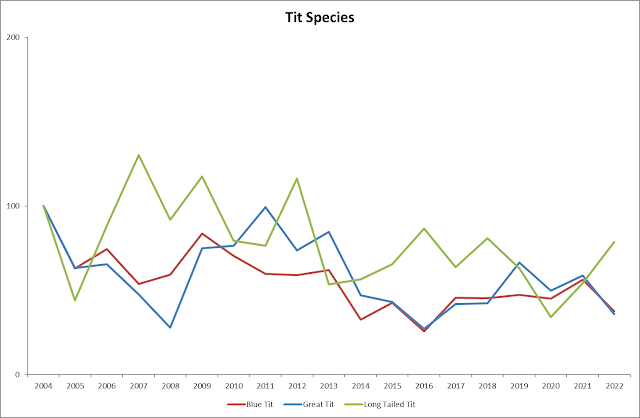
The following graphs show abundance over the past 19 years indexed to 2004 at 100.


Those species declining are notably the three common tit species and the Little Grebe has not been recorded since 2020.


Of the 61 species recorded this year and last 5 were not recorded this year with only 4 new species recorded. 

Between 2021 and 2022 40% of species increased by more than 10%, 42% declined by more than 10% and 18% remained stable.

This is a very brief and cursory examination of the data, more is sure to follow although that may take some time. Tomorrow I will collect the memory cards from my trail cams and complete another year of that data collection, an annual update will follow once they have been analsyed.


Monday, 14 March 2022

Spring is here

 The last few days have been gorgeous, today, in particular, was lovely and warm with clear blue skies. In the last week or so the snowdrops have given way to the daffodils and today I saw the first celandines in flower.

The willow trees are just coming into bud and today I pottered about my patch looking to increase the amount of wet woodland. The willows I planted a few years ago to thicken the wood have taken well and so I took 7 or 8 good branches about a metre long and pushed them into the soft ground to extend coverage across the front. It's very easy to propagate willows in this way, obviously, this is not a genetically diverse way of doing it but the premise of more to develop wet and fallen wood stock in the area, which in turn will be great for insects and subsequently birds.


With the high winds over the last winter a couple of the Alders are a little worse for wear and they do not seem to be being replaced in the stock. There are plenty of 20-30 and older Alders on my page along the backwater but I cannot think of a single young tree or sapling coming through. There are plenty of dead trees which the woodpeckers love but slowly they are falling (which I leave in place). I think this year I may buy and plant a few Alders if I can find a suitable stockist.

Moving away from the plants the Roe Deer were about again, just the usual three and I m constantly amazed at how quickly they can blend into the background. 

Given how mild the winter has been this year I was not expecting many of the winter visiting finches but this weekend saw several flocks of Siskin and Lesser Redpoll. The Redpoll were still on site today and I managed to get a shot of this handsome fellow.


There are still plenty of signs of Otter, in fact yesterday I found a new otter spraint in a very different location. I have noticed that the otters on otter cam like to climb on a fallen log and spraint there. When at the far end of the meadow I found a spraint a good metre off the ground on a horizontal branch.


In the first photo, you can see the distinctive fish scales and the second shows the branch on which it was left, quite a height off the ground. I m guessing that this stops and floodwater washing away the mark? I perhaps should have given it a smell just to check its origin, something to check out next time.

Friday, 31 July 2020

Appreciate the space you have

Throughout much of lockdown and the "new normal" the weather has been very kind to us and I have found myself both working and sitting in the garden. 
I would consider the 40 squares metres outside my backdoor a fairly conventional sub urban garden. It has a neat patio with a central lawn bordered by shrubby plants. There is a small pond in one corner and a long leylandii hedge down one side. It sits squarely in a 1970's housing estate on the edge of a small town. It is in many ways completely unremarkable, and yet this little patch is alive with activity.


There are currently 8 house sparrows sat on the lawn eating the crusts of yesterdays sandwiches. These are our most abundant visitors, we are lucky in this area that sparrow numbers seem to be doing so well. They are a gregarious and noise bunch at times. They have a favoured thorny bush into which they retreat when threatened and squabble incessantly. 

At this time of the year the young hatched in the spring are entering adolescences many species especially the tit ones still show hints of yellow where there will soon be white and the young magpie looks like he has been soaked to the skin and then dragged through a hedge backwards. This year we have had a pair of young robins their speckled breasts only now showing the rusting which will develop into the vibrant orange breast. A few young blackbirds dodge the adults. Chased from one side of the garden to the other, unsure why the parents that once fed them now seem so disinterested. A pigeon nests in the hawthorn at the bottom of the garden and has been churning out chicks at a startling rate. The adults parade around the garden and this year seem intent on fighting and or mating at every opportunity.

Starlings are present in smaller numbers than usually, any seed and bread put out is usually devoured in seconds by these greedy gorks, where once tens used to visit now only handfuls. In place of the starlings come the feral pigeons, watching from the rooftops until the bread of seed is throne out and then descending like a mass of evacuation helicopters.

 Dunnock's skulk in the undergrowth emerging only occasionally emerging at its edge. A wrens trilling song can be heard, a fairly new visitor to the garden as is the song thrush which after years of absence has been sighted on a handful of occasions this year. Rare visitors include the Sparrowhawk who seems most grateful for our bird feeders as is the great spotted woodpecker who loves the peanuts. Only occasional visitors in the summer but more so in the winter are the goldfinches and chaffinches which are often joined by pied wagtails in the coldest months. These are just the common birds, we have had blackcap, reed bunting, brambling and goldcrest all visit at least once.

High above the garden other birds pass, the lazily gliding  buzzard, the languid herring gulls which call to make this central England locale sound positively coastal and the fast zipping screaming swifts and chattering house martins.

These are just the birds. Families of wood mice live in the hedge and under the bin store, grey squirrels hang from the branches to reach peanuts, a single brown rat tries to sneak food from the birds and before attempts were made to stop the rat we used to have hedgehogs, these now are restricted to the front garden. Frogs frequent the pond and lay their spawn each spring. The flowers attract a range of bees and hoverflies who industrially and methodically move from bloom to bloom. Yellow Ants live under the lawn and in the large plant pots will the more familiar black ants restrict themselves to the nest between the cracks in the patio paving.

The buddleia draws in large whites, tortoiseshells, peacocks, red admirals, and painted ladies whilst winds blow in holly blues, commas, meadow browns, gatekeepers and speckled woods. Whilst not living in the pond brown and common hawkers sometimes whirr in and take a turn around the garden.

What I am trying to show here is the diversity of life on our doorstep. This is one pretty average garden. Its not the mega fauna of  the Serengeti but the life stories and the dynamics between survival and death are just as vivid as any Savannah grassland or tropical forest. A little time spent sitting in the garden can reveal in depth stories of infidelity between dunnocks, unwanted attention between woodpigeons and social hierarchy amongst mice.

Ecology isn't something that happens out there. Too often people believe to see nature you must go to nature reserves or that walks in the country are best, and to be fair those are all great things. I would advise everyone to go out and explore the countryside, visit our reserves but don't forget what is on your back doorstep. The nature here amongst the more mundane species is just as important. That which is abundant and local can so quickly become rare and endangered. In my life time song thrushes have gone from common a garden bird to rarity to be cherished when seen, outside our area house sparrows are declining alarmingly and starling numbers are falling.

If we don't appreciate the small things how can we ever hope to stop them  becoming the rare? How can we hope to understand the big issues, the global ones, after all the tropical rainforests and african grasslands are just somebody else's gardens and back doorsteps.

Sunday, 15 July 2018

Heat Wave and Birds

https://ww2.rspb.org.uk/community/wildlife/f/13609/t/82953.aspx
Unless you have been living under a rock for the past month you will be abundantly aware of the heat-wave Britain is currently experiencing. Normally I am writing about long winters or prolonged snow but warm weather can be as disruptive.

Birds lack sweat glands and so are unable to sweat to lower their temperature, instead, they must cool their body temperature via respiratory regulation and use behavioural changes. A bird’s natural body temperature is naturally higher than a mammal, between 37.7-43.50C.

If the temperature of the air exceeds 380C (which thankfully it isn’t in this heatwave) then birds actually undergo extreme stress which actually increases the body temperature until it dies. So to avoid this, birds undertake 3 cooling methods.

1.       Non-evaporative cooling – by raising feathers and spreading them out air is allowed to flow over the skin and cool the bird.

2.       Cutaneous cooling – as well as wind cooling the skin, can be cooled by water evaporating, due to the lack of sweat this is a lot slower but can be improved if the bird baths.

3.       Respiratory evaporative heat loss – This is seen as panting and many species of bird do this. By flushing their throat tissue with blood their allow heat to dissipate.

Birds will take behavioural changes such as seeking shade or sitting with their back to the sun, their feathers raised.


It is just as important in the summer to keep feeding the birds. Energy is needed to thermoregulate and sometimes heat waves cause scarcity of local resources. It is important to provide water baths and troughs for them to drink from, ponds are especially valuable. 

Sunday, 1 July 2018

The Humble Sparrow

Now a declining species in many parts of the UK Warwick is blessed with a decent sized population of the once ubiquitous House Sparrow (Passer domesticus). Many disregard this common bird as drab and boring but I find them charismatic and fascinating.

Their ever-present cheerful cheeps and squabbles fill our gardens all year long and this year I took a closer look when I began to notice a higher than usual incidence of mating.
 
Male Sparrow (c) M. Smith

 I first did a deep dive on the House Sparrow in 2012 when I was looking at comparing sparrow numbers in two different housing estates. I was looking to see if numbers were different between two adjacent estates, one built in the 1950’s and one in the 2000’s. My dataset was poor and the results were inconclusive, however, it did mean I read a lot about this bird.


The sparrow evolved in the Fertile Crescent (modern day Iraq and Iran) some 10,000 years ago. It spread widely with populations now found across the western Palearctic. In Britain, there is an estimated population of between 2,600,000 and 4,600,000 individuals which is believed to be an underestimate. This may seem a huge number but this is following a 45% decline in numbers between 1967 and 1999.

Female and Male Sparrow (c) M. Smith

Sparrows are mainly granivorous birds, only feeding their week-old young insects. This led the species being linked to agriculture and small villages where they nested in buildings. During the 19th century, the species was having such an effect on crops that local Sparrow Clubs were set up in every parish in an attempt to eradicate them.

Declines in the cities seemed to be linked initially to the disappearance of the horse but later was more closely linked to the types of building and housing. In natural habitats, House Sparrows are gregarious colony breeders, building nests in caves or old trees. Early housing with poor roofing provided excellent artificial nest sites. Pre-1919 buildings have been found to be favoured the most but with the advent of plastic fascias and smaller gardens, suitable nest sites have been declining since the 1960’s and markedly more so since the 1980’s.

Sparrows keep in good condition by dust bathing, here on the canal towpath. (c) M. Smith
The sparrow has become dependent on mankind and its dwindling numbers are caused by an increase in pesticides reducing chick food, herbicides reducing adult food, haymaking occurring prior to seed set, reduced spillage of grain and better storage of grain and an increase in predators like Sparrowhawks and cats. In fact, studies on cat predation have shown that 28% of prey taken by cats were sparrows. Squirrels are also frequent nest raiders and will often chew through nest boxes to get the nestlings.

Breeding takes part from February onwards with as many as 4 broods a year possible. Unlike their distant cousin, the Dunnock (Hedge Sparrow) House Sparrows are mate faithful. Nest are built in holes in buildings or trees. Dominance in males is marked by the breadth of the black bib and chest and mating can be solicited by both the male and the female. I have seen this, this year. Early in the season, I watched a male pester a female for 20 minutes. Calling intently and flitting closer and closer until the female relented and yet weeks later I watched another female on the fence actively encouraging to mate. In both cases coupling was quick but repeated, I counted 8 copulation with a 3 minute period.

The act (c) M.Smith


Clutch sizes tend to be between 3 and 5 eggs which are incubated for 11-14 days with an 11-19 fledging period. Young birds emerge all looking very similar to the female with males developing their characteristic caps later in the season. The young birds continue to be supported by their parents for awhile and beg for food by rapidly flapping their wings and calling. Eventually these young will join packs of other fledgelings and adults in small flocks that squabble together loudly.

Two fledgelings being fed by an adult male (c) M. Smith


Friday, 25 May 2018

Nature, red in tooth and claw

The cycle of life was brought into sharp relief yesterday when a Sparrowhawk caught a juvenile Starling in the garden. 


The young starlings have been quite prolific this year and there are several noisy families on the estate. Starlings once a common sight in gardens is actually in decline nationally even though locally they still seem to be doing well. The species have been red-listed by the IUCN and are a local biodiversity action plan listed.

Sparrowhawks, on the other hand, have a favourable conservation status and in the UK have increased in number considerably since 1974. This is partly due to reduced persecution and increased brood sizes.

The individual show in the picture is a female, no doubt catching food for some nestlings somewhere. You can tell it's a sparrowhawk rather than another raptor or falcon by the distinctive thin 'knitting-needle-like' legs. You can tell it is a female from the brownier plumage and lack of yellowish buff neck and front.


Sunday, 20 May 2018

Consider the duck - a philosophical musing


Although the bridge is still out of action I still go and have a drink down the mill, read a book and watch the world go by. Last week I watched a Heron hunting and this week a lone male Mallard caught my eye. He was comfortably paddling amongst the reeds oblivious to those of us on the terrace sipping drinks or finishing of a platter of breakfast.

Mallard Drake (c) M. Smith


He swam slowly, almost leisurely between the vegetation pausing to dip his head down to sample the food below. Finding a good spot he would upend in the traditional fashion un self consciously showing everyone his white rear end as his neck delved below.

As I watched his antics I consider how his life varied from mine and what that meant. I placed myself in his webbed feet. Were our roles reversed my life would revolve around basically food and sex, not bad you might say but dig a little deeper. Most of his day would be taken up foraging for food just to make it to another day. During my degree I explored Optimal Foraging Theory; this is the delicate balance species have to make between expending energy in gaining energy. It is no good expending 300 calories of effort to get only 200 calories of reward. In the wild this seemingly complicated mathematical analysis is innate, get it wrong and you die, get it right and for time being you get to live. It is a concept now being exploited in computer games, the survivor genre is often accompanied by zombies or the apocalypse as in State of Decay 2 or Metal Gear Survive but the ingredients are the same, get food, water, medicine first or you won’t survive long enough to turn back the zombie horde or to build the best outpost.

Balancing life and death decisions on this level is something we are remote from. Consider the duck again; he will forage for as long as he is able. He must find a suitably safe roosting spot and in the long term find a mate with which to procreate. The basics of being an organism, I, however, had just paid for someone to give me a cola and if I so wished would have brought me food. In 5 minutes my sustenance needs were met, I had a home for shelter and even more food and drink waiting for me there and I was able to spend the next hour just sat reading a book. Okay the money I used had to be earned and I spend 5 out of 7 days achieving that but what leisure time did the duck have and what did it do with it?

The critical point for mankind was the development of farming, the minute we could produce more food than we needed daily we became something new. Free time was invented when we did not need to spend all day hunting and gathering when we could build houses and walled towns to protect ourselves. Free time is what allowed the development of civilisation. That free time allowed for hobbies, tools and weapons didn’t need to be merely functional; they could be intricate and beautiful. Time spent drawing, painting; singing no longer interfered with the basics of staying alive. Art for art’s sake, for pleasure, was possible. Humankind was able to begin its dominance over the world. But let us not forget that we are still one species amongst many, that our roots are the same as a dog or monkey.

Do animals do things for pleasure? This is a more complex issue than I wish to address today but let’s look at an animal further along the scale, say a cat. Domestic cats have their meals provided and have a shelter so what do they do with their spare time. Well, like all good followers of optimal foraging theory they conserve energy, they sleep, but they also go out and hold territories, they don’t need them but they still do it. They hunt, they don’t need to but they still do. They play, they don’t need to hone their skills to hunt, but they still play. Are these innate hold over’s from a pre-domestication time. Has the passage of time not been long enough for basic urges to be overcome as they seem to have been in man or perhaps the cat has chosen to do these things with its free time? Are we then in thousands of year’s time to see the art and civilisation of animals we have raised up or as David Brin may have put it – uplifted?


And yet the duck keep paddling about until I have finished my drink and I have decided to go home and make myself a sandwich.

Saturday, 24 February 2018

Disability day at the feeders

First of all, I apologise for not posting for awhile but a touch of the flu laid me out for 2 weeks. I am all better now and this weekend I have been out and about, checking my trail cam, counting swans and watching the birds in the garden.

We have a new feeding station which contains mealworms, suet pieces and white sunflower seeds and this afternoon I watched the birds adjust to this new item in the garden in the sunshine. The first to approach was a Starling followed shortly by a Robin which has started to exhibit mating signs and nesting behaviour. 

Most interestingly a single Blue Tit came to feed exclusively on the dried mealworms. This individual had a dishevelled look and a deformed beak - see below.


Such deformities are not uncommon in Blue Tits. In this case, the beak is longer than normal with a hyperextended upper mandible. 

Such deformities are found in many Tit species and the BTO Garden Watch has documented the rise of this possible disease. 

Data from British Trust for Ornithology - https://www.bto.org/volunteer-surveys/gbw/about/background/projects/bgbw/results/types 
Such deformities in the beak are not fully understood and is named as Avian Keratin Disorder (AKD). This relates to the fabric of the beak itself which is a keratin sheath over bone. It has been suggested that because keratin continues to grow like our fingernails that the defect is due to the beak not getting worn down but this does not explain many of the cases.

If the beak deformity is too extreme then it will have a negative effect on the ability for the bird to feed itself and die fairly quickly. In this case, the beak has not hindered the birds feeding although it is possible that such birds only survive at feeders and would struggle foraging for itself. It would be interesting to see if the deformities occur in wild populations. Are they an example of over-identification in well-watched gardens or is their survival greater in gardens.

Whilst the causes are not fully understood some research has been taken in America. AKD was first recorded in Alaska in Chickadees (North American relatives of the Tits) in the 1990's and was subsequently recorded in Nuthatches and Crows. USGS scientist Dr Colleen Handel began investigating the occurrence and originally started looking at organochlorine poisoning and strontium depletion before coming across the possibility of a pathogenic cause.

Blacked-Capped Chickadee. Photograph by: Alan D. Wilson, www.naturespicsonline.com
Her studies involved genetic level studies of the birds and revealed an RNA virus in the  Picornnavirus family that she named Poecivrius. This virus was found in 100% of birds studied with the deformities and only 22% of those without it. The paper was published in 2016.

It is likely that the real cause is more complicated than just a virus and although promising this was a small study which so far has not been followed up and there appears to have been no work to identify the virus in British populations.

You can report any sightings of birds with deformed beaks to the BTO - https://www.surveymonkey.com/r/MF9PHYJ?sm=8eLw8z78HLBP8EQrk4oCQA%3d%3d

Whilst the Blue Tit continued to feed a Woodpigeon tentatively approached the bird feeder. He seemed less skittish as usual and his behaviour was slightly off and it soon became apparent. He was blind in the right eye, in fact, he had no right eye at all. It's hard to tell from the picture if this was a result of injury or a birth defect.


The bird seemed well fed and otherwise unaffected, such a disability is rarely seen it usually increases their chance of predation that they do not last long. However, by looking around more and shifting his head the pigeon seems to be doing fine although the loss of depth perception gained from two eyes meant his landing was a little clumsy.


References:

Zylberberg M, Van Hemert C, Dumbacher JP, Handel CM, Tihan T, DeRisi JL. Novel Picornavirus Associated with Avian Keratin Disorder in Alaskan Birds. mBio. 2016;7(4):e00874-16. doi:10.1128/mBio.00874-16.

Wednesday, 27 December 2017

Pecking order

Amidst the slushy snow that arrived overnight the birds in my garden struggled against the cold. Whilst I ate my breakfast I watched with interest as each species behaved differently. Sometimes it is just be watching the commonest of birds the most interesting things can be observed.

Here then is a photo essay of the birds in my garden this morning (Apologies for the picture quality but it was cold and so most pictures were taken through the patio window!).

The first bird I saw was the Pied Wagtail. We only ever see the wagtail in the winter months. We can get up to two at a time but never more, unlike the town centre which can get small flocks of between 20 and 30 that all roost together. For such a small and seemingly cheerful bird, it was interesting to note that today he was near the top of the pecking order. Usually placid and cautious he guarded the ground feeder where the seeds were zealously seeing off Blue Tits, Sparrows and even the Robins.


The usually feisty Robin would normally be chasing the smaller birds off however a second Robin seemed to take all its attention. Robins are well known for their aggression between each other. Even in this cold weather, they had made the decision that it was more important to defend territory and then feed itself. This shows some measure of long-term planning, its energy levels were high enough that the pay off in the long run of having access to a stable food source was more important than the short term food gain and the possible loss of the food in the future.


Here you can see the Robin in an aggressive pose with tail up low beak and wings out.

Also on a territorial defence footing were the Blackbirds, at this time of year there is a large influx of Blackbirds from the continent. Our native birds are joined by individuals from Scandinavia, the Low Countries and Germany.
Whereas the Robins fought consistently the Blackbirds were able to tolerate each other's presence a little more only chasing each other off if they got too close to each other.

The usual bully boys, the Feral Pigeons, Starlings and Woodpigeons all relaxed their aggressive behaviour and focused instead on feeding. They have large bodies more insulated from the weather but have strong flight muscles that need refuelling, in this case, they opted to eat rather than chasing off competitors of other species.


The ubiquitous House Sparrows seemed to behave no different than normal. They whizzed around like a mix of a squadron of fighter jets and a horde of excited children. Chattering and squabbling and diving into feed whenever a feeder was free. The picture below shows a male with his feathers plumped up against the cold. Birds do this to trap a layer of air next to the skin that creates effective insulation against the cold.


The Hedge Sparrow or Dunnock likewise did not change behaviour, skulking around the edges bothering no one and being bothered by no one.

The last two species to mention are two rare visitors to the garden, both with different strategies, the Goldcrest and the Blackcap. Both are warblers although the Blackcap is considered more of a spring/summer bird.

The Goldcrest is a specialist of conifers and is tiny in comparison to the other birds. It remained cautiously in the leylandi darting quickly from branch to branch. Their small size means they have a high metabolism and must feed nearly constantly to ensure they can survive each night. They have dainty beaks that they use to hunt out hibernating insects and spiders in the branches.


Like the Goldcrest the Blackcap is insectivorous. It can usually be seen hunting green caterpillars in the spring, but insects are scarce in the winter. Like many warblers, Blackcaps are actually migratory and spend the winter in the Mediterranean or North Africa however they are many that have started to overwinter in the UK. Some might not be British birds but individuals moving south from Scandinavia. Like many birds they can change their diet, Sparrows feed their young insects but feed mainly on seed themselves whilst in this cold spell the Blackcap could be seen pecking at peanuts and taking seed from the grounder. Seeds are excellent food in this weather, containing important energy stores like fats and oils. Its is because of well stocked gardens that this usually summer only visior can now stay all year round.


These were not the only birds to visit today, Blue Tits, Great Tits, Chaffinch and Goldfinch all entered into the web of politics which is the English garden, vying for space and food.

What is on exhibition here is a model called Optimum Foraging Theory, something I studied in detail at University. It dictates the optimum time to feed, how long to feed and what to feed on, It guides organisms by causing them to evaluate costs and benefits of their actions. What is interesting is that their motives may seem strange to us, perhaps nonsensical but survival is the name of the game and each has adapted itself to ensure it lives to see another day.